Flying carry on only means everything you own for the trip fits in one cabin bag plus the personal item every passenger is already allowed, and nothing ever goes into the hold. You skip the baggage carousel, you avoid the checked-bag and gate-check fees, and a delayed suitcase stops being a problem because there is no suitcase to delay. It takes about 30 minutes of planning and a weigh-in the night before, and the hard part is deciding what to leave behind, not compressing harder.
Most people fail this trip on weight, not inches. A bag can be comfortably inside the standard 22 x 14 x 9 inches and still get weighed and rejected on a route flown by a carrier that caps cabin bags at 8 kg. So this guide walks the whole sequence: confirming your allowance, building a capsule, packing it, weighing it, clearing security, and handling the moment a gate agent hands you a yellow tag.
Table of Contents
What You Need
Before you pack anything, get five things straight. Each one takes about five minutes and together they prevent almost every carry-on failure I have seen at an airport.
- Your airline’s exact allowance — the size limit, the weight limit, whether a personal item is included, and what your fare class gets you. Screenshot it.
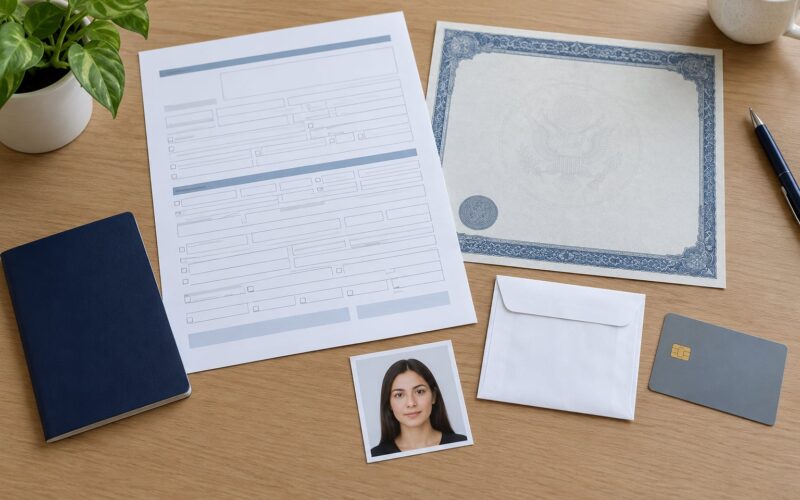
- Travel documents — passport or acceptable ID, any visa or entry paperwork, and a digital copy stored somewhere you can reach without your bag.
- A boarding pass — in an app on your phone, or printed. A screenshot works too.
- A payment method — for the rare case of a café, an emergency bag wrap, or a duty shop on a long layover.
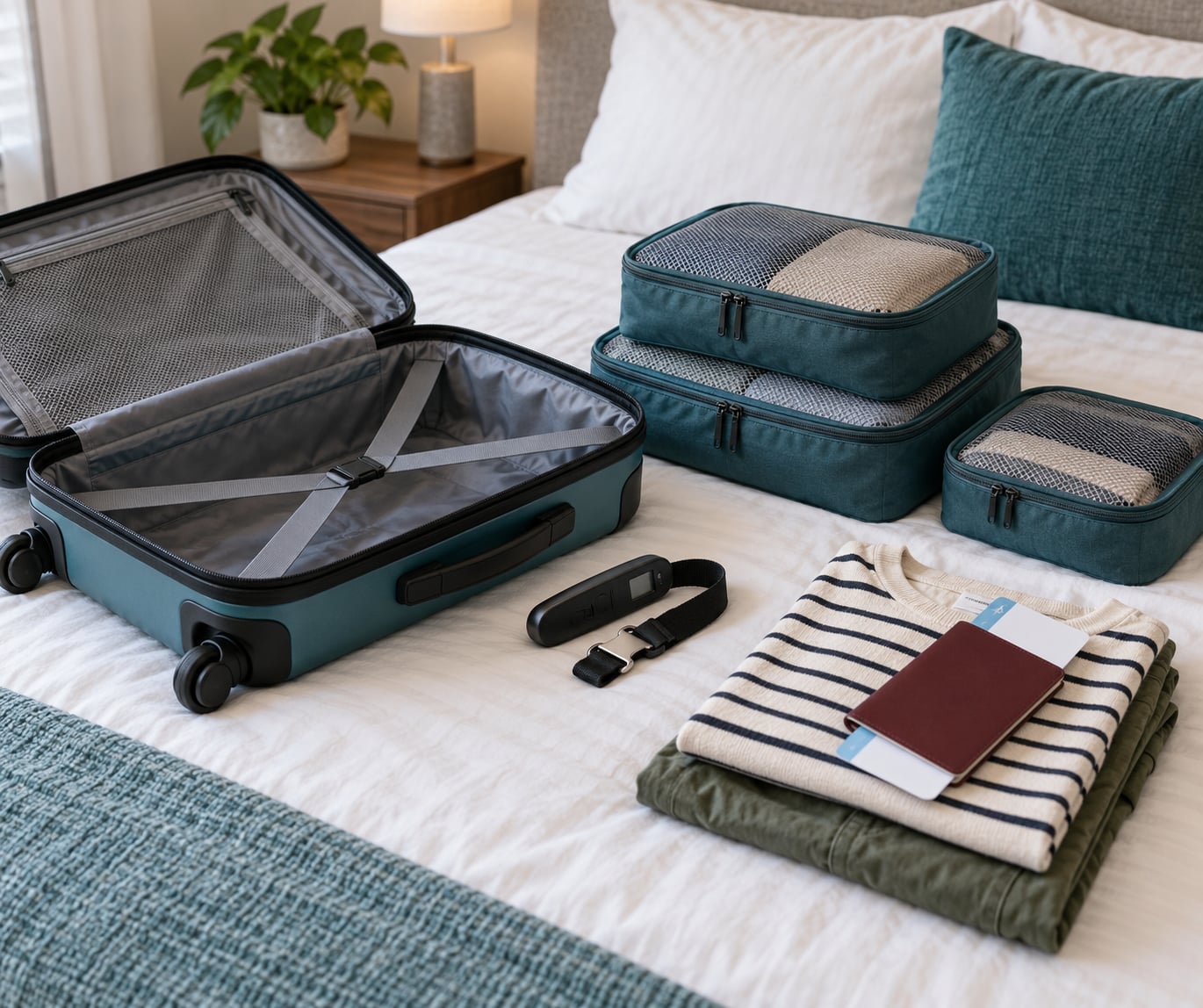
- A luggage scale — a cheap spring scale that hooks to a handle. This is the single most useful item on this list.
- Packing cubes and one compression cube — or zip bags of the same size. Organization matters more than gear.
A bottle of water for after security is worth carrying too, since you cannot take an empty one through the checkpoint and will want one on the other side.
How to Fly With Carry-On Only: Step-by-Step
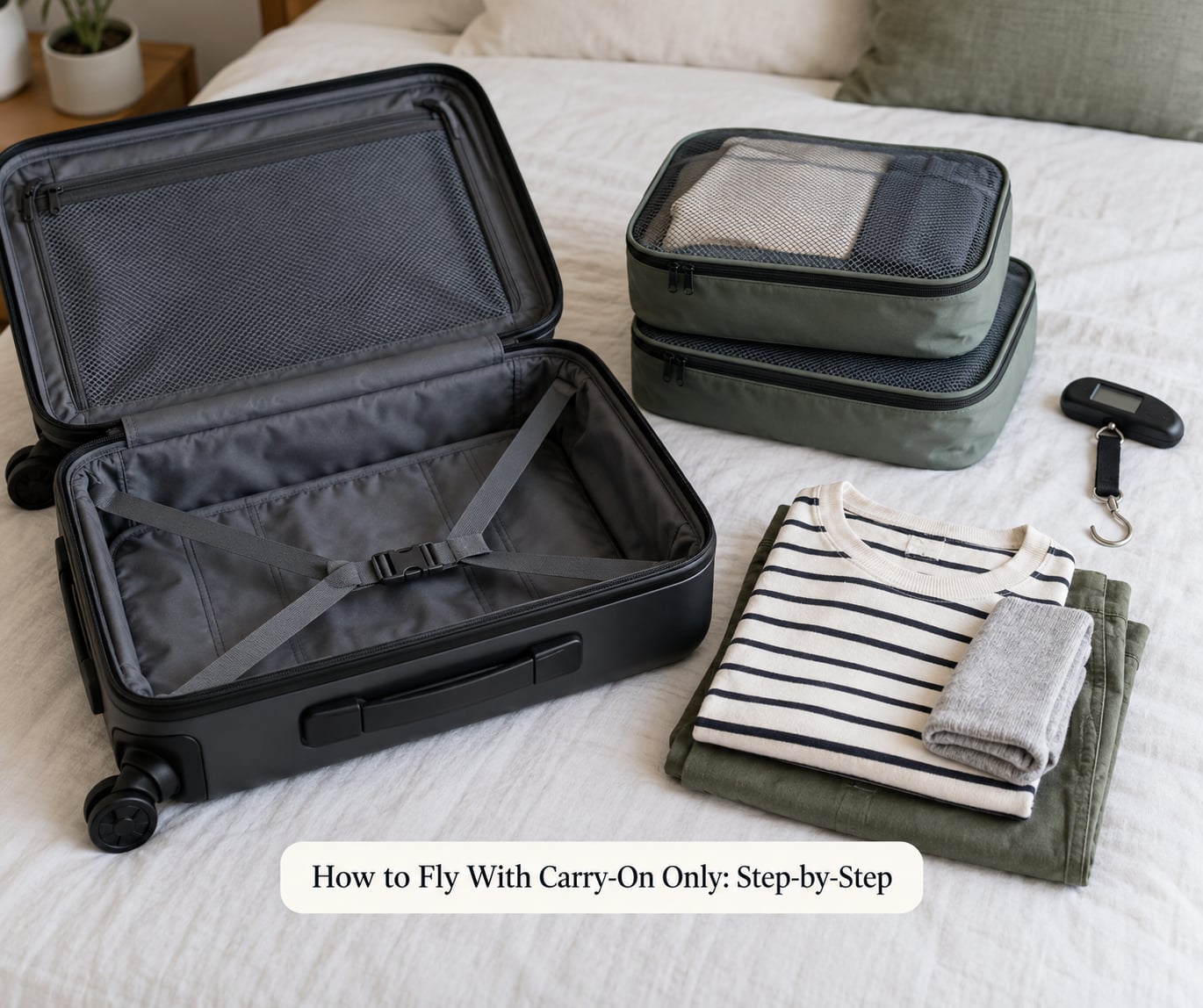
Step 1: Check Your Airline’s Carry-On Rules
A carry-on is a cabin bag that fits in the overhead bin, usually 22 x 14 x 9 inches (55 x 40 x 23 cm). A personal item is the second, smaller bag that must fit under the seat in front of you, and it is free on nearly every fare class. Weight caps are the part most people skip: many international and low-cost carriers weigh cabin bags at 7 to 10 kg and send anything heavier to the hold at the gate.
Check the rules on the operating carrier, not just the code on your ticket. A booking sold under one airline’s name can be flown by a partner with a tighter allowance, and a codeshare itinerary with two different airlines on two different legs can have two different sets of rules.
| Carrier type | Typical size limit | Weight cap | Personal item | Carry-on included? |
|---|---|---|---|---|
| US network carriers, main cabin | 22 x 14 x 9 in (55 x 40 x 23 cm) | Often none published, though sizers are strict | Yes, underseat size | Usually, but not on the cheapest basic-economy fare |
| European and Asian network carriers | Often 55 x 40 x 20 cm, and some set a kg cap too | Commonly 7 to 10 kg | Varies; some fold it into the same allowance | Usually, varies by fare class |
| Low-cost carriers | Often smaller, sometimes 55 x 40 x 20 cm | Frequently 7 to 8 kg | Sometimes, sometimes an extra fee | Often charged separately, and sometimes costs more than a checked bag |
| Regional aircraft, small planes | Smaller bins, and a strict underseat-only policy for some | Usually not weighed | Yes, and it is the most reliable bag you have | Yes |
Read the fare-class line carefully. Basic economy on several US carriers does not include a full carry-on, which is why boarding passes sometimes say carry-on not allowed. If your itinerary is basic economy and you are committed to a carry-on, paying to upgrade the fare is usually cheaper than paying for a bag at the airport.
Step 2: Choose What You Can Skip
Pack for activities, not for the calendar. Nobody needs seven distinct outfits for a four-day city break, and the person who plans one capsule wears everything more than once anyway.
Start by writing down what you will actually do. Museum morning, two dinners, one long walk, one hot afternoon. Then build a small palette of two to three colors that mix with the shoes you already own, and pick pieces that work in several combinations. One outfit that dresses up and down beats a separate day look and night look.
| Trip length | Tops | Bottoms | Underwear and socks | Plan |
|---|---|---|---|---|
| 3 days | 3 | 1 to 2 | 3 sets | Pack a capsule, wear the bulkiest shoes and jacket |
| 5 days | 4 | 2 | 5 sets | Add a layer for cold evenings and one dressed-up piece |
| 7 days | 5 | 2 | 7 sets | Pick quick-dry fabrics, plan one laundry session mid-trip |
| 10 to 14 days | 5 to 6 | 2 | 7 sets, wash and reuse | Carry detergent sheets, budget for a laundromat or hotel service |
The 3-3-3 rule that circulates on packing forums is a useful pressure test rather than a law: three days of clothing, three essentials, three days of underwear. The 5-4-3-2-1 version scales it up, and both work best when you treat the numbers as a ceiling rather than a shopping list.
Step 3: Pack Efficiently and Lightly
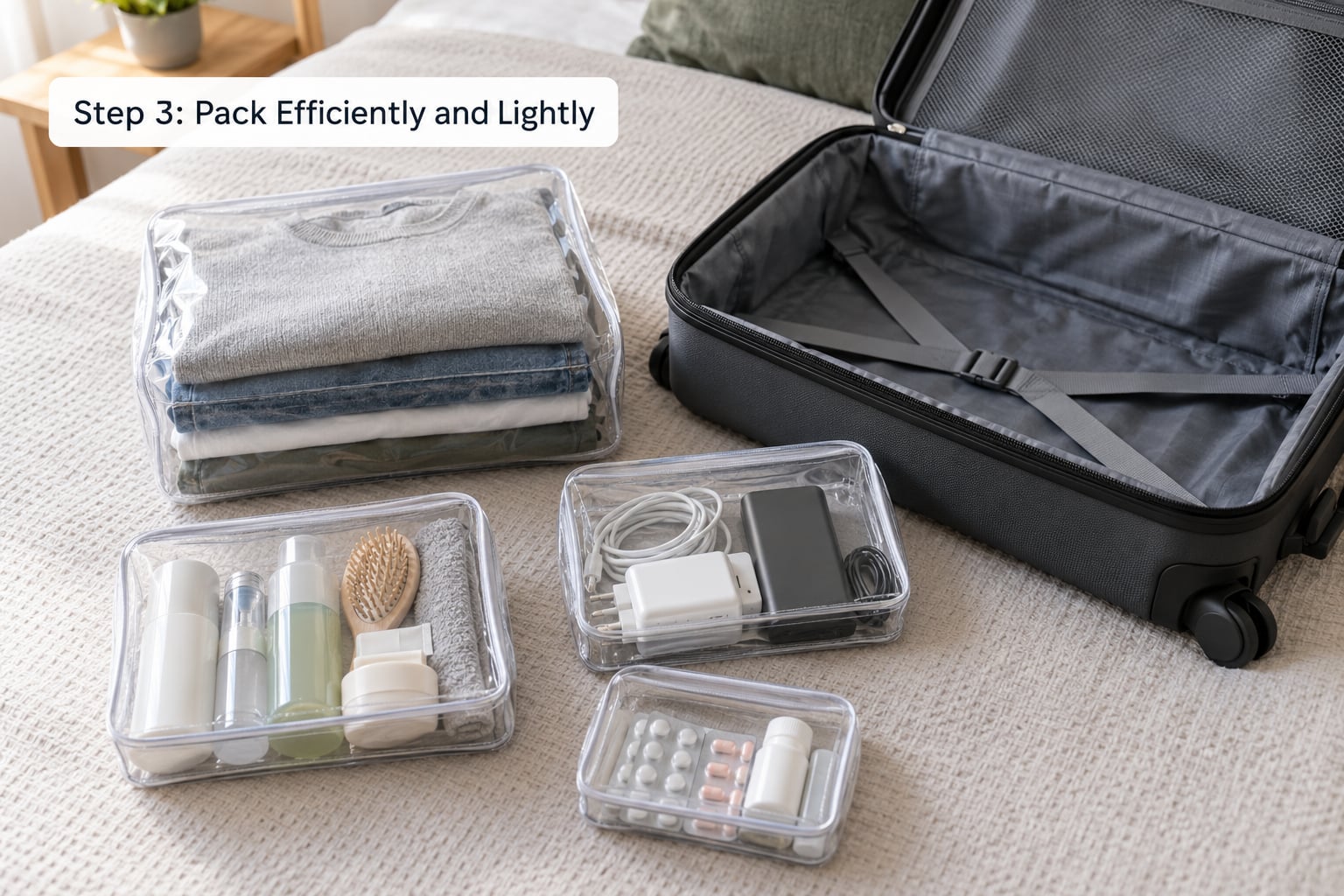
Rolling saves space for knits and jeans, folding works better for shirts and structured pieces, and a mix of both usually packs smaller than doing either one thing to everything. The real gains come from grouping, so sort into categories first: tops in one cube, bottoms in another, underwear and socks in a third, then zip everything flat.
Compression cubes squeeze out air from knits, towels and sweaters, which are the items that actually eat a bag. A caveat worth knowing: over-compressing a zip cube for a whole trip can break the zipper, so pack heavy things loose and use compression on the bulky soft layers only.
Then fill the dead space. Socks go inside shoes, small garments tuck into shoes, and the lid of a suitcase holds the flat awkward items. Wear the bulkiest shoes and the heaviest jacket in transit, which frees up more space than any gadget in the bag.
Protect the fragile and the essential. Medication goes into the personal item, not the bottom of the main bag. Liquids get sealed in zip bags so a leak does not ruin a week of clothes. Electronics and anything with a lithium battery stay in the cabin, never in a checked bag.
Step 4: Weigh and Measure the Bag
Weigh the bag when you are done packing, not the morning of the flight when you cannot change anything. Hang it on the scale for thirty seconds, include the wheels and the handle, and write the number next to the limit. Most people who miss a weight cap on an international route are two or three kilos over, which is one layer too many rather than a genuinely huge bag.
To trim weight fast, pull out the third pair of shoes, the full-size toiletries and the spare towel before you pull out anything you might need. Check the shape in the airport sizer or measure at home with a tape measure including the bulging side, because a soft-sided bag that is technically compliant can fail when it is overstuffed.
Step 5: Prepare Liquids and Restricted Items
In the US, liquids in the cabin are limited to containers of 100 ml (3.4 oz) or less, all of them inside a single quart-size clear bag. That bag comes out at the checkpoint, goes through the scanner, and goes back in. Other countries apply the same basic idea with their own agencies, and rules can differ at connecting airports, so check each departure point if you are connecting.
Go around the rule rather than against it. Shampoo bars, conditioner bars, solid soap and stick deodorant need no bag at all, and a screw-top travel bottle of 100 ml that you never fill past the line keeps the whole kit compliant. Sunscreen, contacts solution and hand sanitizer are the usual offenders, and buying them after security or at the destination is cheaper than binning a full bottle at the checkpoint.
Prescription medication in its original labelled packaging belongs in your carry-on, and it is legal in the cabin. International rules usually require a copy of the prescription or a doctor’s letter, and controlled substances can be restricted in specific countries, so check the destination’s rules before you fly with anything unusual.
Power banks and spare lithium batteries must travel in the cabin, never in checked luggage, and a large power bank can be refused boarding entirely. Knives, tools, trekking poles, camping stove fuel and most sporting gear are prohibited in the cabin. E-cigarettes stay in your pocket, not your bag. If you need gear that cannot fly in the cabin, rent or ship it rather than gambling at the gate.
Step 6: Get Through the Airport
Arriving without a bag to check buys you real time. You can skip the bag-drop counter, walk straight to security, and be through the checkpoint with time to spare rather than standing in it.
The order runs check-in, then security, then boarding. At check-in, confirm your seat and confirm the carry-on is on your booking. At security, pull out your liquids bag, your laptop if you have one, and anything large enough to need its own tray, then put them in the bins. Boarding usually starts in groups, and being in an early group is a genuine advantage: you load the bin yourself and choose where the bag sits.
On board, underseat stowage is the safer home for a soft bag, and overhead bins fill from the back forward, so a bin space near the rear of the aircraft is often easier to find. Keep your phone charged and your essentials with you, because you will be asked to stow the bin bag before takeoff regardless of which group you boarded in.
Step 7: Handle a Possible Gate Check
Gate checks happen to compliant bags. The usual reasons are full overhead bins, a smaller aircraft with tighter bins, a codeshare flight on a partner’s aircraft with a stricter policy, and last-minute changes in how the cabin is loaded. Travelers describe the same bag passing on one flight and being tagged on another, which is why nobody can promise a carry-on is guaranteed.
It helps to know that a free gate check at the gate is a normal courtesy on most carriers, and that fees for checking at the gate are usually higher than checking in advance. If you get tagged, you have a few seconds to do three things: ask whether the gate check is free for your ticket, take your essentials out before the bag goes down, and ask whether the bag will be delivered or delivered to the carousel.
The travel insurance angle matters here. Many standard policies exclude a bag that the airline checked at the gate, so travellers who depend on the contents of their cabin bag after a diversion need a policy that covers it.
Here is how you prevent it. Board as early as your group allows, keep the bag within the size limit by actual measurement rather than by the manufacturer’s claim, and put soft personal items in the bin on top rather than underneath. If you are connecting through two airports, keep a change of clothes, your medication and your documents in the personal item, because a gate check on the first leg can take everything in the main bag with it.
Common Mistakes
These are the errors that cost people their carry-on status, roughly in order of how often they happen.
- Reading the wrong airline’s rules. Fix: check the operating carrier for every leg, and check the fare class line, not the headline.
- Trusting a container’s printed size. Fix: measure the actual container you own, including the cap, and keep it under the limit with room to spare.
- Overpacking and then compressing. Fix: pack to the formula, not to the bag’s apparent capacity.
- Putting medication in checked baggage. Fix: medication, and a spare dose, go in the personal item and stay with you.
- Wearing untested shoes. Fix: walk a full day in them before the trip, because broken-in-on-the-plane footwear is a real risk on a walking-heavy itinerary.
- Burying essentials. Fix: phone, wallet, keys, passport, medication and one change of clothes live in the personal item, always.
- Assuming compliant means guaranteed. Fix: keep an empty space in the bag and know your plan B for a gate check.
Carry-On-Only Tips
A few things that make this sustainable rather than a one-trip stunt.
- Use a colour palette so every top works with every bottom, which is what actually makes seven days possible.
- Choose fabrics that are wrinkle-resistant, quick-dry and washable, and buy one item that does all three jobs.
- Keep detergent sheets in the bag for trips over a week. Long-haul one-bag travellers get a full extra week out of one sink wash or a laundromat stop, and hotel laundry services exist almost everywhere.
- Use the personal item allowance properly. A backpack absorbs overflow that has to disappear before boarding, and it is more useful than a shoulder bag for that reason.
- Travelling as a couple or a group, combine allowances. Two adults with one bag each plus a child with a full-size allowance have more room than people expect, and it is the easiest fix for a two-person trip.
- Skip the checked-bag fee, but do the math on fare classes first. On low-cost carriers a paid carry-on can cost more than a checked bag, and buying a checked bag for a long trip with heavy gear is often the honest answer.
- Keep local research separate from luggage. Knowing what is legal and safe at your destination matters far more than whether the bag fits, and local sources are the right place to check.
Two reader-tested ideas from the onebag community are worth stealing outright. Experienced travellers cap backpacks at 40 to 45 litres, because anything larger is regularly refused as oversized. And the community consensus is to verify each operating carrier’s rules yourself, every time, because fare classes and codeshares differ and rules change without announcement.
Frequently Asked Questions
Can I take a full-size toiletry bag in my carry-on?
You can, but only if every liquid container inside it is 100 ml (3.4 oz) or smaller and all of them fit in one quart-size clear bag. A full-size bottle of shampoo or lotion in a normal toiletry bag gets pulled aside at security and discarded. The practical fix is solid bars for shampoo and deodorant, plus screw-top travel bottles filled only to the line. Buy the full-size products after security or at your destination instead.
How do airlines measure a carry-on bag?
Airlines use a rigid sizer box that must fit the bag, wheels and protruding handles included, and the standard target is 22 x 14 x 9 inches (55 x 40 x 23 cm). On international and low-cost routes they often weigh the bag on a scale as well, commonly at 7 to 10 kg. An overstuffed soft bag can bulge past the sizer even when its printed dimensions are compliant, so measure the packed shape.
Can I bring prescription medication in my carry-on?
Yes, and it belongs there rather than in checked luggage. Keep it in the original pharmacy packaging with the label showing the prescription, and carry a copy of the prescription or a doctor’s note. Medications that are controlled or injectable can have country-specific rules, so check the destination’s regulations before flying internationally. Never pack medication where a lost or delayed bag could mean missing a dose.
Does a laptop count as my personal item?
On most airlines the laptop is not counted as a bag at all. It has to come out of your carry-on and go through the scanner in its own tray at security, then can go back in. Because a laptop bag and a personal item are usually separate allowances, travelers often carry a small backpack as the personal item and a laptop sleeve inside the carry-on. Some budget carriers are stricter and require the laptop to be the personal item itself.
What should I do if my carry-on bag is gate-checked?
Ask whether the gate check is free for your fare, take your phone, wallet, passport, medication and valuables out before the bag is tagged, and ask where the bag will be delivered. A free gate check is normal courtesy on most carriers, and the fees charged at the gate are usually higher than checking in advance. Keep one change of clothes in your personal item so a diversion does not leave you stuck.
Can I fly internationally with carry-on luggage only?
Yes, and it is often easier internationally because many carriers use stricter weight caps rather than larger bins. Watch the kilogram limit, which is commonly 7 to 10 kg, and note that some European and Asian carriers use 55 x 40 x 20 cm instead of the US 22 x 14 x 9 inches. Check the operating carrier on every leg, confirm the personal item is still included, and leave room for souvenirs you did not plan for.
Conclusion
To fly carry on only, do three things in order. Confirm your allowance on the operating carrier for every leg, including the weight cap and the fare class. Build a small capsule, pack it into cubes, and weigh the bag the night before rather than the morning of. Then move documents, medication and one change of clothes into the personal item, so a full overhead bin costs you a delay instead of a lost trip.