
What to do when a friend comes out to you is simpler than it feels in the moment: thank them, tell them plainly that it does not change your friendship, and ask what they need. That is the whole job. Everything else, the questions, the privacy, the follow-up, is detail around those three sentences.
Coming out means telling someone you know that you are lesbian, gay, bisexual, trans, non-binary, or otherwise queer. It is not one event. Plenty of people disclose in small ways over years, a joke at a bar, a partner mentioned in passing, a new name in a group chat. Some people call the softer version inviting in, and they are not being precious about it. They are describing something real.
You do not need a script, a speech, or a personal origin story. You need ten seconds of not talking over them, and then one honest, specific sentence.
Table of Contents
What You Need
Nothing to buy and nothing to read first. The prerequisites are small, and mostly about you rather than the conversation.
An unhurried moment. If you have twenty minutes before you need to drive somewhere, say so before you start. Rushing creates the exact pressure your friend just took a risk to escape.
Your own reaction, noticed but not performed. Surprise, confusion, sadness, a weird burst of energy, tears. All normal, all allowed. None of them are your friend to manage. If something is genuinely uncomfortable for you, that is your work, not their burden.
A private setting. A car, a walk, a closed door, a corner of a bar. Not a group chat, not a room with your other friends in it. Being closeted is a real kind of safety, and privacy protects it.
Permission to have no answers. You do not have to know the right response. You can say, honestly, I do not have a smart answer for that, and I am still here.
Step-by-Step: How to Respond When a Friend Comes Out
Pause and listen without making it about you
The most common fear is freezing, and freezing is survivable. A beat of silence reads as you taking it seriously, not as you failing.
Let them lead. If they give you one sentence, take the one sentence. If they keep talking, let them keep talking, and do not interrupt to assemble your response. Fill the gap with something small and true.
Thank you for trusting me with this.
That sentence does most of the work on its own. It is specific, and it does not comment on the identity itself, which keeps the focus on the act of telling you rather than on what you think about it.
Thank them and validate their experience
Next, name what you are not saying, because silence gets misread as indifference. Say the sentence out loud. I am not surprised is not the sentence to say. This does not change us is.
This does not change us. I am still your friend, exactly the same as this morning.
Mirror their energy instead of exceeding it. If they are relieved and laughing, you can be relieved with them. If they are shaking and trying not to cry, match that. People on the receiving end of these conversations remember the calm version years later, not the loudest one.
And do not deliver your own story yet. The moment a friend tells you something vulnerable is the worst possible time to explain that your cousin came out too, or that you always suspected. Both land as a redirect.
Ask only the questions they want to answered
Why are you gay is not a question. Almost nobody agrees on an answer, and asking it turns their identity into a puzzle for you to solve. If you are curious about a label, ask what it means to them, and accept the answer without a follow-up trap.
Helpful questions:
- How are you doing about it?
- What do you want from me right now, listening or advice?
- Is there anything you have been hoping I would say?
- Who else knows?
- Do you want to tell me more, or would you rather talk about something else?
That third question is worth memorizing. People frequently have rehearsed a sentence for years and never had anyone to say it to.
Respect their privacy and naming choices
Ask directly who can know, and treat the answer as binding. Some people tell their closest friend and nobody else. Some want a slow drip to family. Some want you to act natural in front of a group who has not been told yet. You cannot know which without asking.
Do not out your friend by reaction, either. A gasp, a look at someone across the room, a dropped voice in a group chat can tell a story faster than words. If you slipped in front of others, tell them quickly and plainly, and ask what they want to do about it.
For names and pronouns, use what they use, from the first day. They/them is a complete pronoun set, not a placeholder you should upgrade later on your own. If you are new to it, practice before you see them, not during.
Offer practical support without taking over
The most useful thing an ally does is often not a statement but a service. A ride to an appointment. A meal. A spare key. A place to stay if family is not safe right now. A quiet room at a party.
Offer, then stop. Do not launch a campaign, research their legal options uninvited, or book them an appointment. Ask what would actually help and wait for the answer. Support that arrives on schedule whether it was wanted or not reads as fussing.
If they mention rejection at home, or trouble at work, that is a real situation with real limits. Your job is a specific offer, not a solution.
Check in afterward
Pick a day, roughly a week later, and send a short message. Not a debrief, not a check on how the coming out went. Something ordinary is usually the most reassuring thing you can send.
How was your week? No need to answer anything about the other thing unless you want to.
Then let normalcy be the point. What people remember years later is rarely a grand gesture. It is a friend who texted about dinner like nothing had happened, and kept doing it for years.
Leave the door open rather than knocking repeatedly. If they want to talk about it, they will. If they raise something months later, treat it as a fresh conversation, not a callback.
Common Mistakes and How to Fix Them
Overcorrecting is the standard failure mode, and it comes from nerves rather than malice. Here is the usual list, with a fix for each.
I’m not surprised. It sounds like a compliment and lands as dismissal, because it removes any possibility that your friend had a hard time. Fix: thank them for the trust instead, and let them know you can be learning about something you did not see.
I always knew. Even if true, it means you never gave them the space to be uncertain. If you suspected, wait for them to tell you, and never bring it up first.
It is no big deal. It was big enough that they rehearsed it. Fix: say it mattered, without making them responsible for your reaction.
I love you anyway. The word anyway implies a conditional, like a favor. Fix: I love you, and nothing about this changes the shape of our friendship.
So how long have you known? Then the interrogation begins. Fix: leave history alone entirely unless they bring it up.
You can tell my parents, right? Never assume. Fix: ask, and accept a no without renegotiating.
Disappearing for four months, then resurfacing with a chip. People do not need a badge. Fix: show up at the same rhythm you always did, and say nothing about your own growth unless they ask.
Steering the conversation to your own queerness, or a relative’s. Fix: save it. Their moment is not your moment, however sincere your intentions.
Piling on once they leave the room. Gossip among mutual friends is the most common accidental outing and the least reversible. Fix: one person, one conversation, no group thread.
Crying harder than they are. Emotion is allowed, but the room still belongs to them. Fix: let yourself be moved, then ask what they need.
Launching a Pride post the same week. The moment is not a campaign. Fix: celebrate on the timeline they choose, or not at all.
A calm, private setting for a supportive conversation

Where you are matters less than whether anyone else can hear. Cars, kitchen tables, and walks on a quiet street all work. Restaurants work if you sit somewhere out of earshot and you do not raise your voice when you congratulate them.
Pick somewhere that does not feel like an interrogation room. Sitting opposite someone at a desk, on a couch facing them with a laptop open, all of that adds friction. Side by side on a walk is often the easiest place for a hard sentence to come out.
Respectful support resources kept nearby
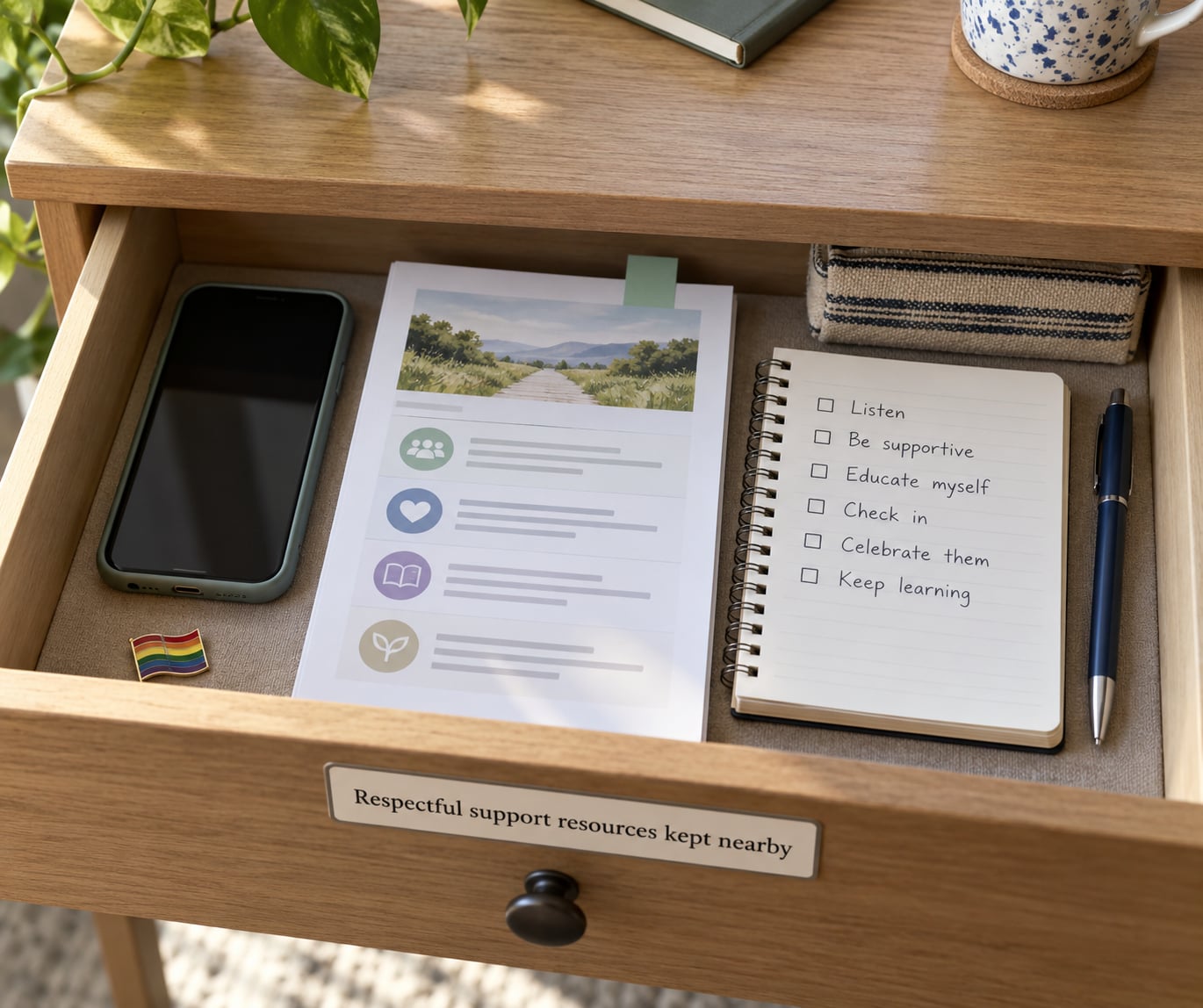
Have real names ready. If your friend wants more than friendship can give, you will not want to fumble for a number on the spot.
Trevor Project is the national crisis line for LGBTQ+ young people, staffed by people who get it. Trans Lifeline runs a peer support line run by and for trans and non-binary people. 988 is the Suicide and Crisis Lifeline, for anyone in immediate distress. PFLAG has family-facing guidance, GLSEN covers K through 12 school policy, and GLAAD publishes media and language guides. Locally, Center on Halsted, Howard Brown Health, and Pride Chicago are good places to point someone who needs a room where nobody blinks.
Keep the list where you would find it quickly, not bookmarked on a laptop you never open. Knowing the name and the number is most of it.
Two things worth holding onto. First, being straight does not disqualify you from being a good ally. Ally means you actively show up, not that you agree with every piece of how your friend lives. Second, the job is follow-up, not a performance. Nobody needs a speech. A friend who remembers a name change, gets the pronouns right the second time, and keeps making plans is the whole thing.
Frequently Asked Questions
What should I say when my friend comes out to me?
Say thank you for telling me, then say plainly that it does not change your friendship. Let them lead, ask whether they want listening or advice, and agree on who else can know. Two honest sentences beat a long speech every time, because what they are really asking is whether you are safe.
Should I ask my friend why they are LGBTQ+?
No. Why are you gay, why are you trans, and why now are all questions that turn their identity into a puzzle you get to solve. If you are curious about a label, ask what it means to them instead. Most people do not have a single clean reason, and the asking itself is the exhausting part.
Can I hug someone after they come out to me?
Usually yes, if the relationship is physically affectionate and the moment is warm. Read their body language and mirror it. If anything feels tense, keep it verbal, since being touched can trigger a lot for someone who has been anxious about this for years. Nodding and smiling is always safe.
What if I accidentally use the wrong name or pronouns?
Correct yourself once, quickly and without a speech, and use the right version from then on. Slip-ups in the first week are common and forgiven. What is not forgiven is refusing to learn or getting defensive when corrected. If you keep slipping, practice before you see them, and do not ask them to help you get it right.
How can I support a friend who does not want advice?
Say it out loud so they know you heard the request: I can talk or I can just listen, whichever you want. Then stick to listening, and shift to practical help, a ride, a meal, company, a quiet place. Do not fill the silence with solutions they did not ask for. Being accompanied is the support they asked for.
Is it okay to tell other people that my friend came out?
Not without permission. Ask directly who else can know, and treat the answer as final, including with mutual friends and in group chats. Accidental outing is the most common breach and the hardest to undo. If you slip, tell your friend quickly, own it, and ask what they want to do next rather than deciding for them.
Conclusion
Listen before you speak. Thank them for trusting you with it. Say out loud that the friendship is unchanged. Ask what they need, agree on who can know, and offer something concrete instead of a speech.
Then check in a week later about something ordinary, and keep making plans. That steady, unremarkable showing up is the thing people remember, and it is entirely within your control. You do not need to have the right words lined up. You need one sincere, specific sentence, and then a second one a week from now.