If you are searching for how to stay safe at a pride festival, the honest answer is that nearly all of the work happens before you leave home: tell someone where you will be, decide how you are getting in and out, know your exits, and go with someone rather than alone. On the day, keep your drink in sight, watch your belongings, set boundaries early, and act on the first moment something feels wrong.
Here is something worth saying up front, because the search results for this question are mostly nervous ones. In the Reddit and Quora threads that fill the top of this search, the recurring story is that the week beforehand felt far worse than the day itself. Pride is mostly a warm, loud, oddly affectionate crowd of people who are happy to see you. Planning is not a way to stay cautious. It is a way to buy yourself the option to leave, so you never have to choose between being careful and having a good afternoon.
This guide walks through the whole process, from the night before to the trip home. Festival policies differ by city and organizer, so treat the specifics below as a framework and confirm the details on the event’s own site.
Table of Contents
- What You Need
- Step-by-Step: How to Stay Safe at a Pride Festival
- 1. Check the festival details before you go
- 2. Make a clear plan with someone you trust
- 3. Protect your phone, identity, and personal belongings
- 4. Set boundaries and stay aware of your surroundings
- 5. Stay hydrated and care for your body
- 6. Handle alcohol, drugs, and other substances carefully
- 7. Know what to do in an emergency
- 8. Leave a Pride festival safely and check in afterward
- Common mistakes
- Frequently Asked Questions
- Can I attend a Pride festival alone and still stay safe?
- What should I do if someone harasses me at Pride?
- How can I protect my phone and personal information at a festival?
- What should I do if I feel unwell after drinking or using substances?
- Where can I get help at a Pride festival?
- Is it okay to leave Pride early if I feel unsafe?
- Conclusion
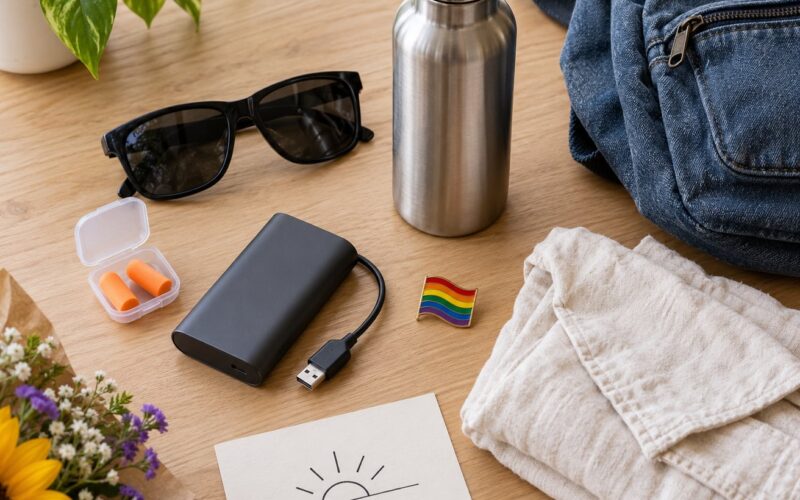
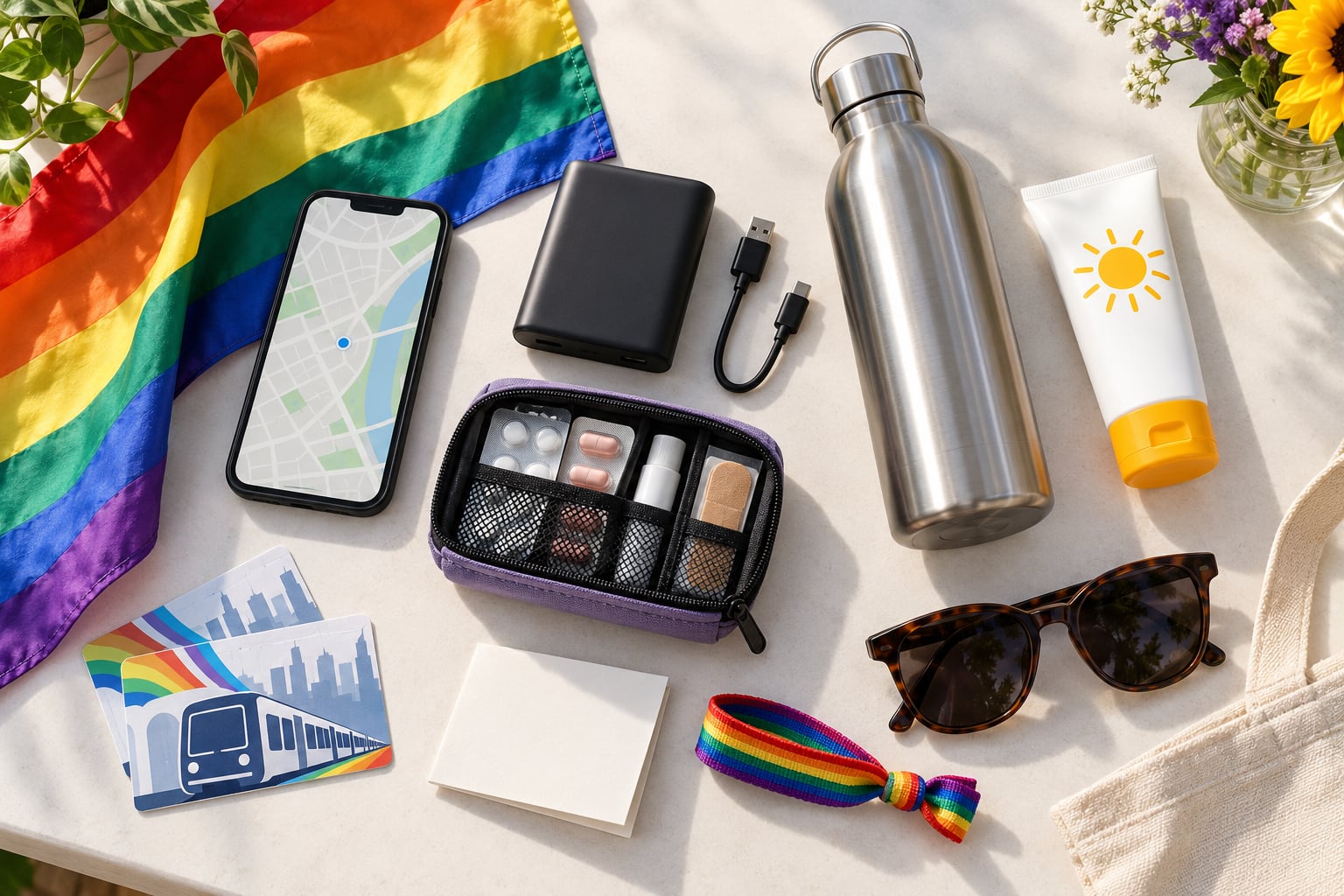
What You Need
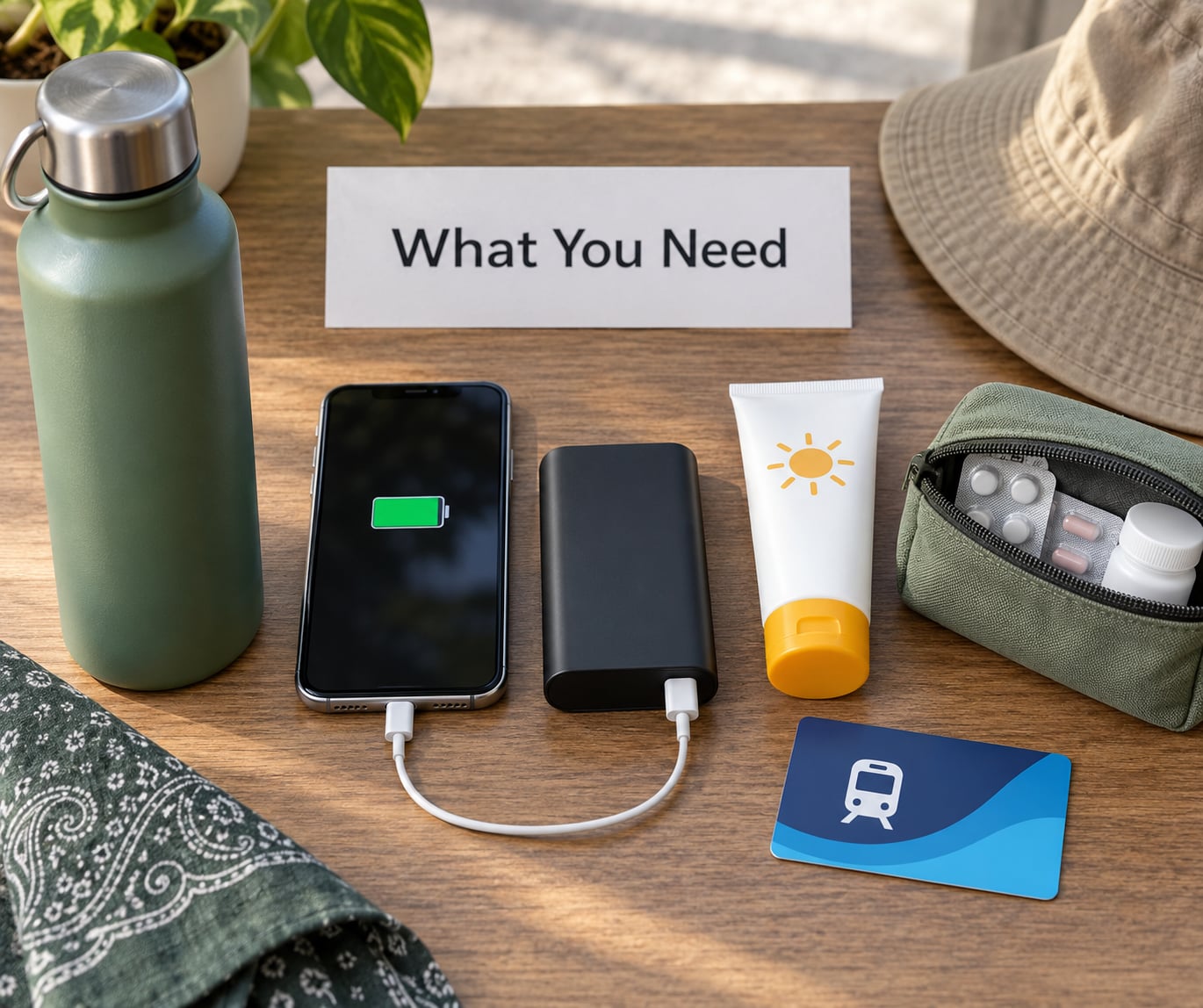
Three decisions do most of the work. Who you are staying with, who outside your group knows where you are, and how you are getting home. Get those three straight and the rest is logistics.
Then pack like you are going to be outside for six hours, because you probably are, standing on pavement, in summer.
| What to bring | Why it earns its space in your bag |
|---|---|
| Photo ID and one payment card | Some events check age for alcohol, and losing every card turns one bad moment into a whole lost evening. |
| Power bank and a short cable | Dead phones are how people get separated. Batteries last the day better than outlets do. |
| Refillable water bottle | Queues cost time and money, and water is the thing you will actually finish. |
| Sunscreen and a hat | Burns sneak up on you when you are busy and moving around. Reapply, do not assume once was enough. |
| Medication, in original packaging | Keeps it identifiable for anyone who needs to help you, and keeps the dosing instructions with the pills. |
| Small towel or wipes | Useful for heat, dust and spilled drinks. Not glamorous, consistently missed. |
| Ear protection | Several hours of amplified music leaves a ringing ear that ruins the rest of the day. |
| Light layer or poncho | Weather turns fast, and you do not want to be the person who leaves early because of rain. |
| Emergency contact on paper | A dead phone cannot call for help. A card in your pocket can. |
| Outfit you can ruin | Older, faded clothes. Nobody has ever regretted a drink landing on a shirt they already hated. |
Wear shoes you have already broken in, not new ones. Blisters are the most common reason people leave early, and they arrive around hour four in exactly the shoes you were excited about at breakfast.
Step-by-Step: How to Stay Safe at a Pride Festival
1. Check the festival details before you go
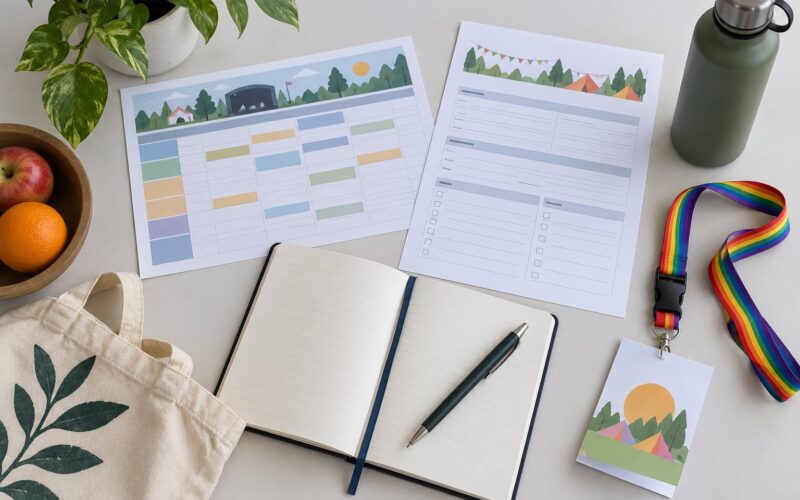
Start with the organizer’s own website and official social accounts, not a secondhand description. You are looking for hours, entrance and exit locations, bag rules, screening, alcohol policy, weather advisories, accessibility information, transport options, and whether the event has a first aid location and a staffed help point.
Two details are worth extra attention. Bag size limits and screening rules decide what you can carry, so check them before you pack rather than at the gate. And note where the entrances and exits are, because the only useful time to build a mental map is when nobody is pushing.
| Organizers usually provide | You have to bring yourself |
|---|---|
| First aid and medical staff | Your medication, water, sunscreen and the judgment to sit down when you are overheating |
| Security screening and visible staff | A charged phone, a power bank and a paper emergency contact |
| Toilets, including accessible units at most large events | Any gender-neutral option you specifically need, plus time to find it before you need it |
| Water stations and shaded or indoor space | Your own bottle, hat and a break plan that does not depend on the schedule |
| Volunteer and help points | Knowing ahead of time that those people exist, and that you can go to them |
Experienced attendees do one more thing that almost nobody writes about: they map their escapes. Pick two exits, one on each side, and decide in advance which one you use if you need to get out quickly. A decision made calmly in the morning is worth a lot at 4 p.m. when you are tired and the crowd has tripled.
2. Make a clear plan with someone you trust
Pick one person outside your group as your check-in contact. Someone not attending is often better than someone in the crowd, because they are not looking at their phone and they will actually pick up.
Share the basics: where the event is, roughly what hours you will be there, who you are going with, and the transport you plan to use home. Then agree on two check-in times, one mid-afternoon and one when you are heading out, and one signal word or phrase that means leave now.
If you are going alone, this matters more, not less. Text someone your location, and if your phone supports it, set a time-limited live location share that expires on its own. Many attendees also open a shared note with their meeting point, so the plan does not live only in a chat that needs signal.
Talk about what happens if you get separated, because you will. Agree on a meeting point that is easy to describe and hard to get lost from, such as a specific stage, a food vendor with a distinctive sign, or a transit station entrance rather than “by the big flag”. Screenshots of the venue map on a saved, offline copy solve the cell service problem that the crowd creates.
3. Protect your phone, identity, and personal belongings
Keep your phone in your hand or in a zipped front pocket, never loose in a back pocket in a dense crowd. Pickpocketing at large events is a grab-and-go crime, and a phone stolen off you is also a way to lose your check-in contact, your transit pass and your photos.
Turn off notification previews on your lock screen. It costs you nothing and it stops personal messages, names and photos from appearing in front of strangers. If you are not out to everyone, consider removing your full name from lock screen settings altogether.
Carry only the cards you need. Photograph the front and back of your ID and keep the copy in cloud storage you can reach from a borrowed phone, and note your card cancellation numbers somewhere you do not need your wallet to find. At a parade or street festival, keep valuables zipped and in front of you, and take your bag off the back of a chair that faces a wall.
Know that you are carrying choices about your identity, and make them on purpose. Some attendees wear a name tag with a first name only, some skip anything with a surname, and some wear an LGBTQ+ pin openly. None of that is a rule someone else gets to set for you.
4. Set boundaries and stay aware of your surroundings
Most harassment at these events is not a dramatic confrontation. It is someone being too close, commenting on your body, photographing you without asking, or following you. Decide your boundary before you are in it, because deciding in the moment is much harder.
It is completely normal at Pride to say no to a photo, to someone asking about your relationship status, or to a hug. A short, flat answer works best, because a long explanation invites a discussion. And if someone ignores it once, leave. You do not owe a second round.
For awareness, note three things when you arrive: where your group is, where the nearest staffed help point is, and where the nearest exit is. After that, keep checking in with yourself. Crowds make it easy to ignore the feeling that something is off, and that feeling is usually doing its job.
Strangers offering to help is not automatically a threat, and the evidence from community threads is that most people who approach you are friendly. Check your own instinct rather than assuming hostility, and choose carefully when a stranger offers to walk you somewhere.
5. Stay hydrated and care for your body
Drinking water on a schedule beats waiting until you are thirsty, because heat and crowding suppress thirst long before you feel it. A few sips every twenty minutes costs nothing. Skip the energy drinks on top of a long day, since caffeine and dehydration make people who are already overstimulated feel worse.
Take breaks before you need them. Sit somewhere cool and quiet for ten minutes every couple of hours, even if nothing feels wrong. It is much easier to leave a crowd rested than to push through and collapse in it.
Sensory load is a real physical thing at a large festival. Noise, music, bodies, heat and unpredictable movement can pile up, and for some people that turns into genuine distress rather than annoyance. Ear protection helps more than people expect. So do a quieter route, a shorter visit, and a plan to leave early that you have already told your group about, so nobody takes it personally.
Know the warning signs of heat illness, which include heavy sweating followed by chills, headache, dizziness, nausea and confusion. If you or someone around you shows those signs, get to a cool place and tell a staff member or find medical help right away rather than pushing through. If you take medication regularly, ask your doctor or pharmacist in advance about anything you should do differently on a long, hot day out.
6. Handle alcohol, drugs, and other substances carefully
The basics of keeping yourself safe around substances have not changed in decades. Keep your drink in your sight or in your hand. Do not accept a drink you did not watch being poured, including from someone whose drink you have been holding. If you lose sight of a glass, pour it out.
Set limits before you start drinking rather than while you are deciding in the moment, and decide on a sober driver or sober ride before anyone buys the first round. Eating food early and alternating with water helps more than people credit.
Choosing to stay sober at Pride is a legitimate safety strategy, not a compromise, and it also solves the getting-home problem entirely. Harm reduction services operate at many large events, distributing free water, clean supplies, testing and information. If one is on site, use it.
Signs that a drink or substance has been tampered with can include extreme sleepiness, sudden confusion, an unusual sense of vulnerability, being told you seem tired when you do not, or simply feeling that something is very wrong. Get to a busy, staffed place, tell someone you trust, and seek medical help. If someone is unresponsive or you cannot wake them, call your local emergency number immediately, and tell responders you suspect a spiked drink, because that changes how quickly they act. Nothing on this page replaces advice from a doctor or a pharmacist about substances and your health specifically.
7. Know what to do in an emergency
On arrival, find two kinds of people and remember what they look like. Organizer staff and volunteers usually wear colored shirts, credential lanyards or volunteer vests, and security is usually clearly identified and near the entrances. Know that help points exist before you need one, because you will not spot a small tent in a crowd of fifty thousand people.
Then work through this in order when something feels wrong.
- Move toward people. Staff, volunteers, security, a food vendor, an open business, a well-lit street.
- If it is harassment rather than danger, distance first, then tell a staff member. You do not have to handle it alone.
- Call the person who knows where you are, so someone outside the situation knows you need help.
- For immediate danger, injury or a medical emergency, call your local emergency number and give your exact location, including the nearest entrance, street or stage.
- For theft, report it to staff promptly. A stolen phone gets locked faster when it is reported while you are still nearby.
- If you are lost, stop moving, go to a staffed point, and use your meeting plan rather than wandering.
Police are one option among several for getting help, and not everyone feels safer dealing with them. You get to decide who you talk to, and staff, organizers, a nearby business or a trusted friend are all legitimate choices. Some attendees also feel safer walking in a group to a transit stop or a rideshare pickup point rather than waiting alone.
If you are followed or feel unsafe on the way home, go into an open business, a transit station with staff, or any populated place, and call your check-in person. Tell them where you are. Do not go straight home.
8. Leave a Pride festival safely and check in afterward
Leaving is where a lot of good days turn, because the last hour is tired, crowded and often the least coordinated. Meet your group at the meeting point you agreed on rather than “somewhere near the exit”, and do it before you are in the flow of everyone leaving at once.
Expect transit platforms to be busy and services to run late after a big event. Check your route before you are in the crowd, keep your card and phone on you rather than in a bag you set down, and confirm that whoever is driving is actually sober before the first person climbs in. Rideshare pickup zones fill up fast, so set the pin before you leave the festival grounds.
Once you are home, send the message you promised your check-in person. Look through your pockets and bags, confirm your cards are still with you, and put your medication away where tomorrow morning can find it. Taking ten minutes to close the day properly is how you avoid a 2 a.m. panic about the wallet you are not sure you brought.
Common mistakes
Almost every safety problem I hear about at these events comes down to one of these.
- Going without telling anyone. The risk is that if something happens, nobody knows where you are or that you need help. The fix is a check-in contact who is not in the crowd and two check-in times.
- Not having an exit plan. The risk is standing around trying to work out your route in the moment you want out of somewhere. The fix is choosing two exits on arrival, before the crowd grows.
- Losing sight of your drink. The risk is a tampered glass you never noticed. The fix is keeping it in hand or in sight, and pouring out anything you cannot account for.
- Wearing new shoes and your favourite outfit. The risk is blisters, chafing and ruined clothes in the exact hours you wanted to be out. The fix is broken-in shoes and something you would not cry over.
- Carrying every card and your full wallet. The risk is that a snatch takes your ID, your transit pass and your ability to get home. The fix is one card, photographed and backed up.
- Waiting until you feel bad to drink water. The risk is heat illness arriving fast in a crowd where nobody notices. The fix is drinking on a schedule and taking breaks before you feel the need.
- Arguing with a counter-protester. The risk is turning a shrug into a confrontation that puts you at the center of it. The fix is disengaging, walking away, and telling a staff member if it escalates.
- Assuming your group will always be together. The risk is forty minutes of panic in a crowd where cell service has failed. The fix is a described meeting point and a screenshot of the map kept offline.
- Placing all your trust in one safety resource. The risk is putting yourself in a situation that feels less safe, not more. The fix is knowing several options in advance, including which open businesses and transit stations are near the venue.
A few smaller things that make a real difference. If it is your first event, go in the middle of the day, stay on the main paths, and leave before the closing ceremony crush, which is when most crowd injuries happen. If you are with children, agree on a meeting point they can find on their own and put a card in each pocket with your number. If you are attending as an ally, the most useful things you can do are follow your friend group’s lead, ask before photographing anyone, and step in loudly if you see someone being targeted.
And if the day is not for you, say so early and without apology. A short, honest “this is not the event for me today” is better for everyone than a friend dragging themselves through four hours because they feel guilty.
Frequently Asked Questions
Can I attend a Pride festival alone and still stay safe?
Yes, plenty of people do, and most report it was fine. Solo attendance is a bit more work, not a reason to skip the event. Tell someone who is not attending where you will be and when you expect to leave, set two check-in times, save a screenshot of the venue map, and plan to move between the main stage, a food area and the exits. If you want company, showing up in a volunteer tent or a community group chat is an easy way to find people without walking alone the whole time.
What should I do if someone harasses me at Pride?
Decide your boundary before you have to, because improvising in the moment is exhausting. A short, flat no works well: no photos, no comments, no touching. If the person ignores it, leave rather than explaining yourself, and do not walk home alone afterward. Tell an organizer or security staff member, since most events have a process for this and staff can act when you cannot. If you are in immediate danger, call your local emergency number. Record what you can remember afterwards, while it is fresh.
How can I protect my phone and personal information at a festival?
Keep your phone in your hand or a zipped front pocket rather than loose in a back pocket, and keep cards in the same place. Turn off notification previews so personal messages and photos do not appear on your lock screen in public, and consider removing your full name if you are not out to everyone. Photograph your ID and back up your cards in cloud storage so a lost wallet is an inconvenience rather than a crisis. Save an emergency contact on paper too, since a dead phone cannot make a call.
What should I do if I feel unwell after drinking or using substances?
Get to a busy, staffed place and tell someone you trust what is happening instead of trying to sleep it off alone. Warning signs of a tampered drink or a bad reaction include heavy sleepiness, sudden confusion, unusual calm or vulnerability, nausea, or a strong sense that something is very wrong. Do not leave the area on your own, and do not drive. Seek medical help promptly, and tell responders you suspect a spiked drink if that is what you are worried about, because it changes how fast they act.
Where can I get help at a Pride festival?
Look for organizer staff and volunteers in colored shirts or credential lanyards, security near the entrances, and the event’s first aid or medical location. Most large festivals also run a help point or information tent, and it is worth finding it on arrival while the crowd is still thin. On the way out, a nearby open business or a staffed transit station works well too. Keep your local emergency number ready, and remember you get to choose who you talk to, including a trusted friend over police.
Is it okay to leave Pride early if I feel unsafe?
Yes, and you do not owe anyone a reason. Tell one person where you are going so they are not worried, then go somewhere with people: a staff member, an open business, a friend, or a busy transit station. Tell your group plainly that you are heading out, which is easier than disappearing and worrying them later. Leaving early is a completely reasonable response to heat exhaustion, sensory overload, or a situation that feels wrong, and plenty of people plan on leaving before the closing ceremony for exactly that reason.
Conclusion
If you take three things from this, make them these: tell someone who is not in the crowd where you will be and when you are leaving, pick a buddy and a meeting point before the day starts, and map two exits while the festival is still quiet enough to see. Everything else in the guide is detail under those three decisions.
Start tonight. Read the event’s site, message the person who will know where you are, and pack the boring things: water, sunscreen, medication, a power bank, and shoes you have already worn a hundred times. You will still dance until your feet hurt, and you will still have the option to walk out whenever you want.