
How to date after a long relationship is mostly a pacing problem, not a confidence problem. Most people who feel rusty after eight or ten years are not bad at dating. They are carrying habits from one relationship into a very different situation. Start with three things: an honest read on your own readiness, a social routine that does not depend on romance, and low-pressure dates you can actually enjoy.
This guide is for anyone coming out of a long, committed relationship who wants to meet people again without rushing or performing. It takes weeks of ordinary life, not one big decision.
Table of Contents
- What You Need to Date Again
- How to Date After a Long Relationship, Step by Step
- Step 1: Reconnect with what you actually want
- Step 2: Build a social routine that does not depend on romance
- Step 3: Choose a dating space that feels comfortable
- Step 4: Create a clear profile or introduction
- Step 5: Start with low-pressure conversations
- Step 6: Set boundaries and watch patterns, not chemistry
- Step 7: Evaluate each date honestly
- Common Mistakes to Avoid
- Frequently Asked Questions
What You Need to Date Again
Emotional readiness is the thing most people get wrong. It is not the same as being over the relationship, and it rarely arrives as a feeling. It is closer to a set of conditions you can actually check.
An honest inventory. Set aside twenty minutes with a notebook and write down what the last few years gave you, what you would like more of, and what you are done tolerating. Write it for yourself, not for a profile. If the list only describes your ex, you are not ready yet.
One person who knows the whole story. A friend, a sibling, a therapist, a chosen family member. Long relationships leave big holes, and the people who fill them in the first months are the ones who will call you after a bad date.
A schedule with slack in it. Most first dates come from ordinary recurring places: a weekly class, a volunteer shift, a regular bar night. If your only plan is to find a date, you will feel pressure on every outing and it will show.
A short list of deal-breakers. Three items, not thirty. Write them where you will see them before you swipe or accept an invitation. Non-negotiables are easier to enforce when you decide them while you are calm.
A simple safety plan for apps. If you are meeting someone from a profile, tell a friend the name, the bar, and the approximate time you will be home. Most people never do this and most people wish they had.
That is the whole kit. Nothing on the list requires you to feel confident first.
How to Date After a Long Relationship, Step by Step
Step 1: Reconnect with what you actually want
Long relationships quietly fold your identity into a shared one. Separate hobbies, separate friends, even separate ways of spending a Sunday. Getting that back is the least glamorous and most useful part of starting over.
Do this in three passes. First, list five things you did regularly before the relationship that stopped. Second, list three you still enjoy and want more of. Third, list what you want your weekly life to look like six months from now, including how much time alone you want.
How to date after a long relationship starts to feel less mysterious here, because you now have preferences instead of habits. Keep the list somewhere you can revise it. Mine has changed twice since I wrote it.
Step 2: Build a social routine that does not depend on romance
Put yourself in a room repeatedly with the same people. A climbing gym, a chorus, a mutual aid group, a weekly dinner. Repetition is what turns strangers into friends, and a friend you like is better company than a date you are hoping for.
Aim for two fixed things a week. That is enough to feel connected and small enough to keep when you are tired. This is also the part that quietly fixes confidence, because you are being yourself in front of people who will see you again.
For queer readers, this matters even more. After a long relationship, the community space that held you and your ex may now be a place where you both still go. Give yourself a month or two of smaller, different rooms before you decide the whole scene has changed.
Step 3: Choose a dating space that feels comfortable
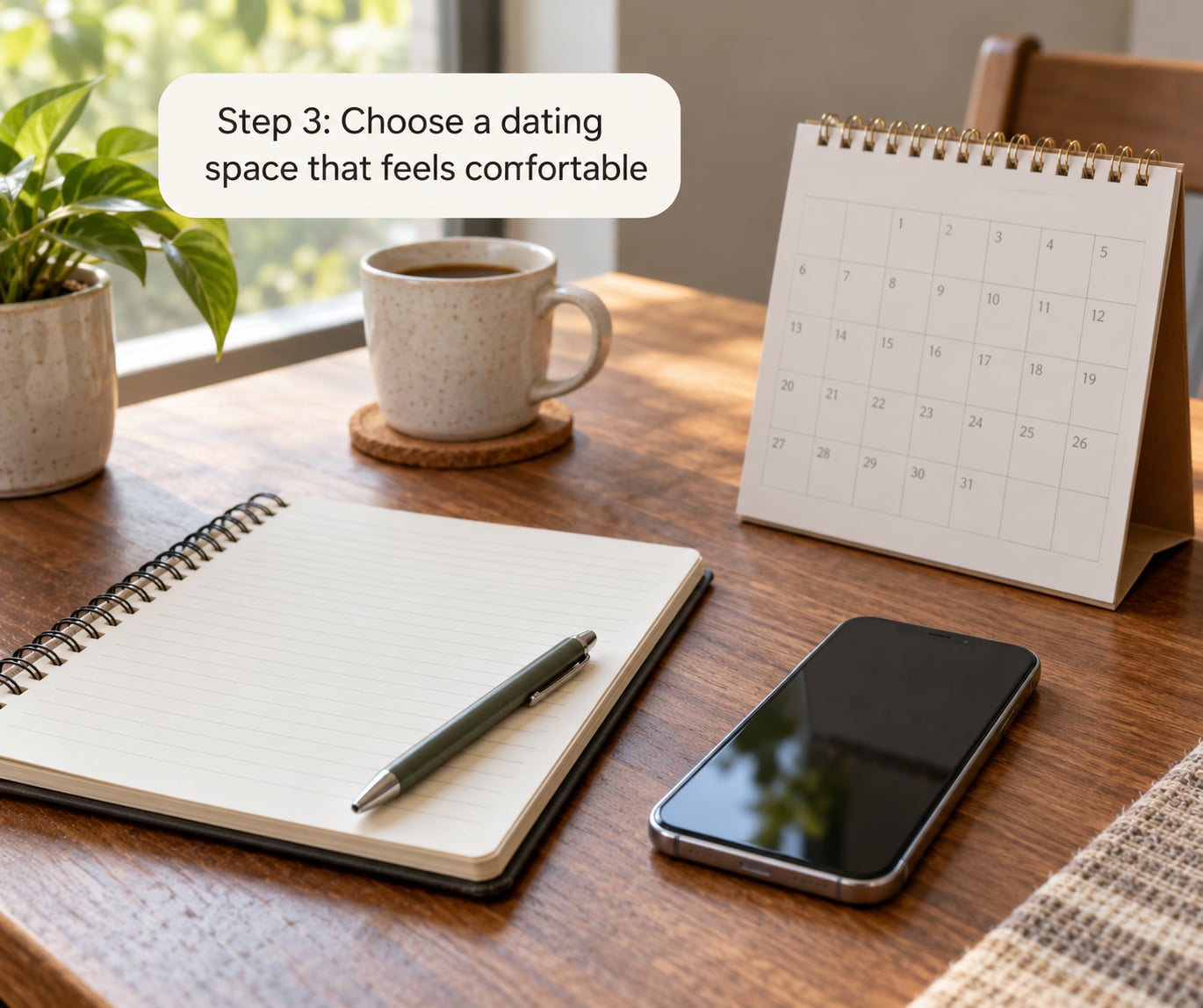
Rank your options by how much energy they cost you. Interest-based groups cost the least. Community events and volunteer shifts come next. Friends-of-friends introductions cost a little nerve. Apps cost the most attention, because the interface is built to make you keep scrolling.
None of these is better in the abstract. Some people meet people at the gym and never open an app. Others have not made a connection in years without one. Try two, not one, and give each a fair run of a few months.
For apps, queer-focused platforms like HER, Lex, Feeld, and Grindr serve very different audiences, so pick based on what you actually want to talk about rather than sheer profile volume. Check whether a potential match respects your pronouns and your name before you invest an evening.
Keep the first meeting somewhere public, familiar, and with a natural end time. A coffee or a drink at 7pm gives you a clean exit without anyone having to explain themselves.
Step 4: Create a clear profile or introduction
Say what you are looking for in the first two lines. Looking for something serious, or open to seeing where it goes. People who read that and swipe anyway are usually a better use of your evening than the ones who guess wrong.
Use specific details. What you cook on a Sunday, which neighborhood you haunt, the show you have been meaning to catch. Vague adjectives photograph badly and start bad conversations.
On your past relationship, one neutral sentence is plenty. I was with someone for a long time and that chapter is closed. Then stop. The same rule applies when a friend introduces you. Nobody needs your ex’s name, the fight that ended it, or the details of the betrayal before they have bought their drink.
You may have heard the 3-3-3 rule, the idea that a relationship should still occupy about three percent of your thoughts a year after it ends. Treat it as a prompt for curiosity, not a measurement. There is no scoreboard, and grief does not follow a schedule.
Step 5: Start with low-pressure conversations
Openers work when they ask for a story rather than a fact. What is your Sunday like. What convinced you to join this thing. What is the worst advice you have ever taken.
Then ask a follow-up and actually listen to the answer. That second question is where real conversation happens, and it is the part people skip because they are busy rehearsing the next line.
Share in layers. Start with something true and ordinary, then watch whether the interest comes back. Reciprocity is the thing to watch for, not charisma. People who ask nothing about you, rush the pace, or only talk about themselves have told you something useful.
It is fine to admit you are rusty. Someone else out there is also remembering how to be funny after eight years of being married.
Step 6: Set boundaries and watch patterns, not chemistry
Say your availability out loud early. Weeknights are for the gym, weekends are open. Someone who respects a slow start is telling you something useful for free.
Name your boundaries in plain language and without apology. I do not do sleepovers on a second date. I need a few days before I introduce someone to my friends. A boundary you state clearly is easier to respect than one you hope people guess.
Judge repeats, not first impressions. A person who is late once might be having a bad week. A person who is consistently vague, pushes for access, argues with you about your boundaries, or disappears when you need them has shown you a pattern, not a mood.
Queer dating after a long relationship has its own version of this. Watch how someone talks about exes and about people they no longer speak to. How they treat a server, a group chat, a former friend tells you more than three good dates in a row will.
Step 7: Evaluate each date honestly
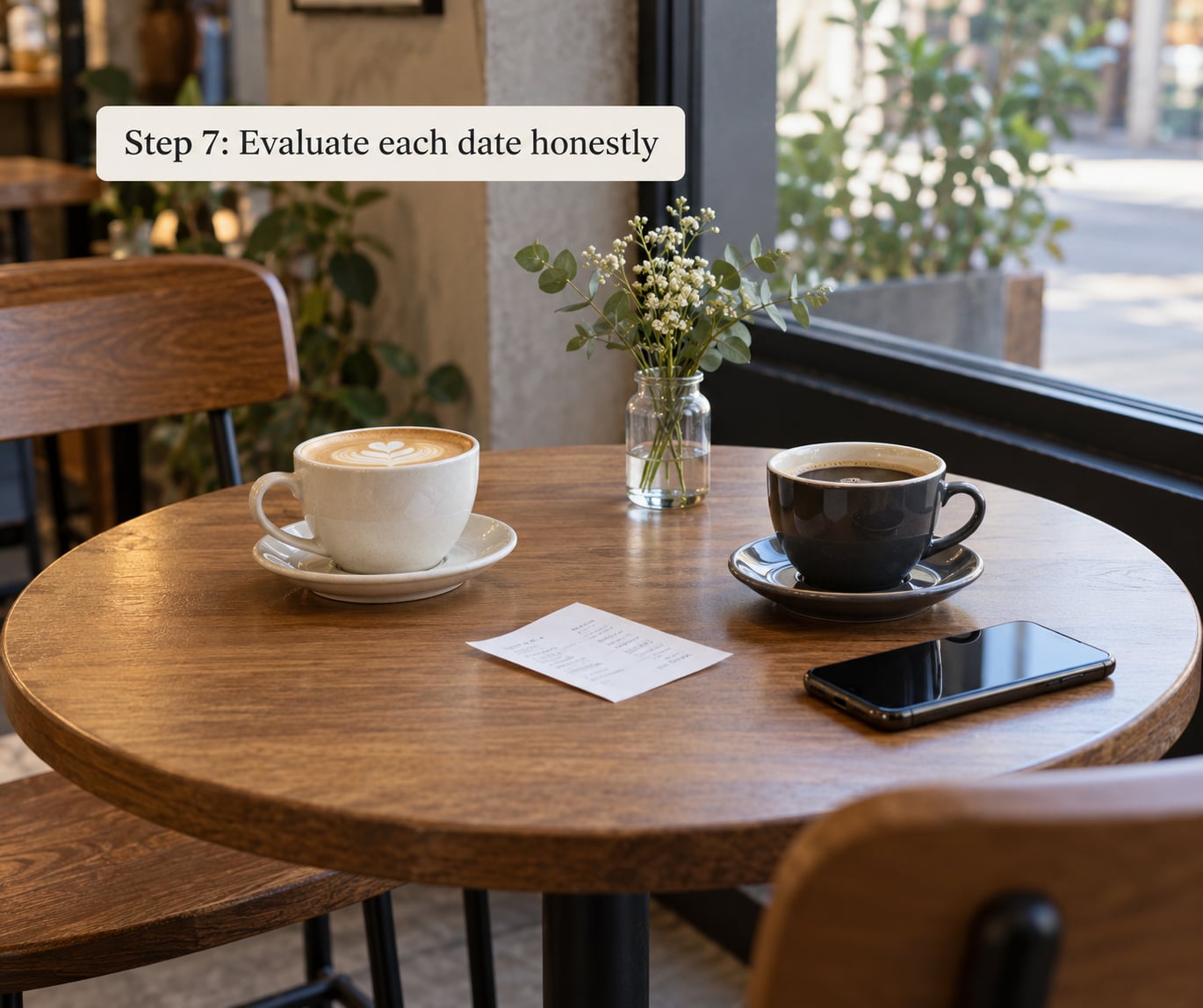
Give each date about a week before you decide anything. The immediate post-date feeling is unreliable. Plenty of people who felt great walked home wondering what happened, and plenty of people who felt hollow went home thinking it went well.
Ask four questions afterwards. Did I feel comfortable around this person? Were they curious about me? Was there mutual interest, or was I carrying the conversation? Would I want to see them again with no expectation attached?
If the answer is yes to the first two and vague on the rest, that is worth a second date. If you spent the whole night comparing them to your ex, say that plainly to yourself. The comparison trap is the single most common reason people end a promising thing early, and it is a habit, not a verdict on the new person.
Ending contact politely is a skill too. A short message, no apology tour. I liked meeting you, but I do not think we are quite the same. Then stop replying. Guilt makes people stay longer than they want to, and it rarely helps.
Common Mistakes to Avoid
Rebounding on purpose. Some people date immediately so they do not have to feel the loss. It usually brings the grief along into the first month of the new relationship, where it has nowhere to go. Fix: set a date on your calendar to start meeting people, and if you are not ready that week, move it once. Not forever.
Treating your ex as the standard. Every new person gets measured against someone who had years of your history and a shared apartment. That comparison is rigged. Fix: compare people to your list of deal-breakers and preferences instead of to a memory.
Oversharing the details of the breakup. The story about your ex’s temper or your worst year is compelling and it is not a first-date story. Fix: keep the wound private, share the lesson instead. What did you learn about yourself that you would want a partner to know?
Rushing intimacy to prove you are over it. The fastest way to feel closer is to move quickly, and moving quickly is how people end up explaining a situation they did not mean to create. Fix: let physical closeness follow real comfort, in the order you actually want it.
Disappearing on your friends. Some people emerge from a long relationship with a social life that only existed because of the couple. It vanishes fast, and then dating feels like your only option. Fix: rebuild your regulars before you rebuild your dating life.
Ignoring the red flags because you like them. Chemistry is not an explanation. Fix: write your deal-breakers before you meet anyone, then read them after a hard conversation rather than in the middle of one.
Treating every date as a test you can fail. Dates are not interviews, and you are not on probation. Fix: go to enjoy an evening with another person, and let it be ordinary.
Frequently Asked Questions
How long should I wait before dating after a long relationship?
Wait until you can talk about the relationship without your voice changing, and until you have a regular week that feels solid on its own. There is no correct number of months, and a calendar cannot tell you. If you are still checking in with your ex, or every good moment gets contrasted with how things used to be, give it more time.
How do I know if I am emotionally ready to date again?
Look at behavior rather than feelings. Are you keeping plans with friends, sleeping reasonably, and able to be interested in someone new without needing them to fix you? Emotional readiness often lags behind readiness on paper, and it shows up gradually. Most people find out by meeting a few people in low-pressure settings, not by waiting for a clear signal.
Is it normal to feel nervous about dating after a breakup?
Yes, and it is close to universal after a long relationship. You are not out of practice for life, you are out of practice for a very specific format of dating, which changes more often than most people expect. Nervousness usually drops once you have been on a couple of dates where nothing bad happened. Plan for the nerves rather than treating them as a warning sign.
Should I be honest about my previous relationship on a dating profile?
Be honest but brief. Mention that you were in a long relationship and that you are open to meeting someone, then move on to what you do now. Profiles that dwell on an ex attract people who want to discuss the ex. If the relationship involved something painful, save the details for someone who asks and who has shown they can hold it well.
How do I tell if someone is not emotionally available?
Watch what they do, not what they say. Available people make time, follow up, and let you into small parts of their life within the first few weeks. Watch for someone who is always busy, keeps conversations at the surface, brings up an ex early, or resists any plan that does not stay late. One slow week is normal. A pattern of avoidance is information.
If you do only one thing this month, put two fixed things on your calendar that have nothing to do with romance. Everything in this guide, from how to date after a long relationship to handling the first awkward coffee, gets easier once your week already holds together. This one was last refreshed for 2026.