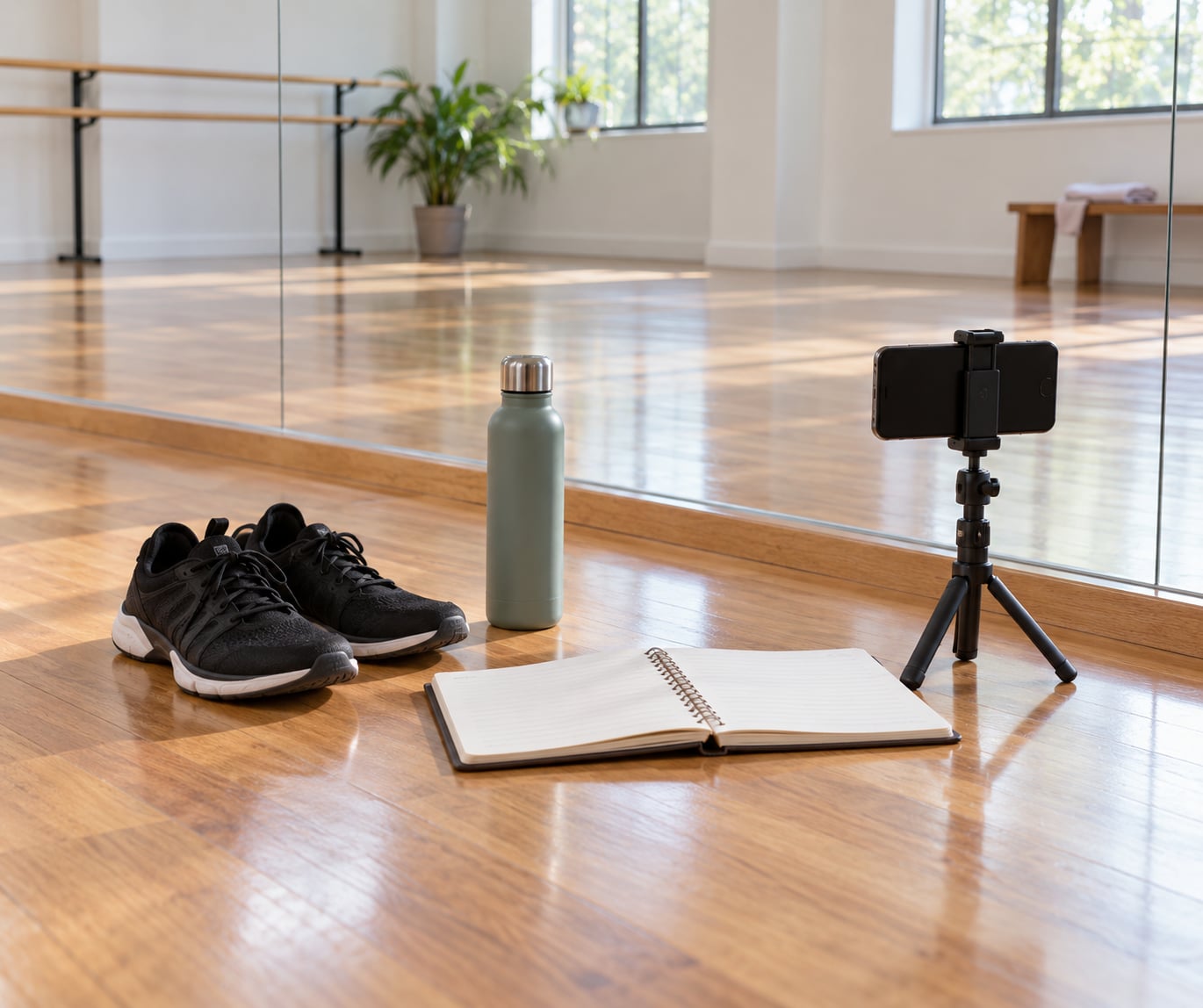
To learn ballroom basics, pick one dance, get the basic step pattern onto the beat, and practise it in short daily sessions before adding turns or a partner. Ten minutes a day beats one long practice a week. Most beginners stall because they start with fancy figures instead of posture, weight transfer and timing.
This guide is current for 2026 and covers what you need before you start, a six-step progression, and the mistakes that slow almost everyone down. You should be able to follow it alone at home, and it still works if you take a class alongside it.
Table of Contents
What You Need
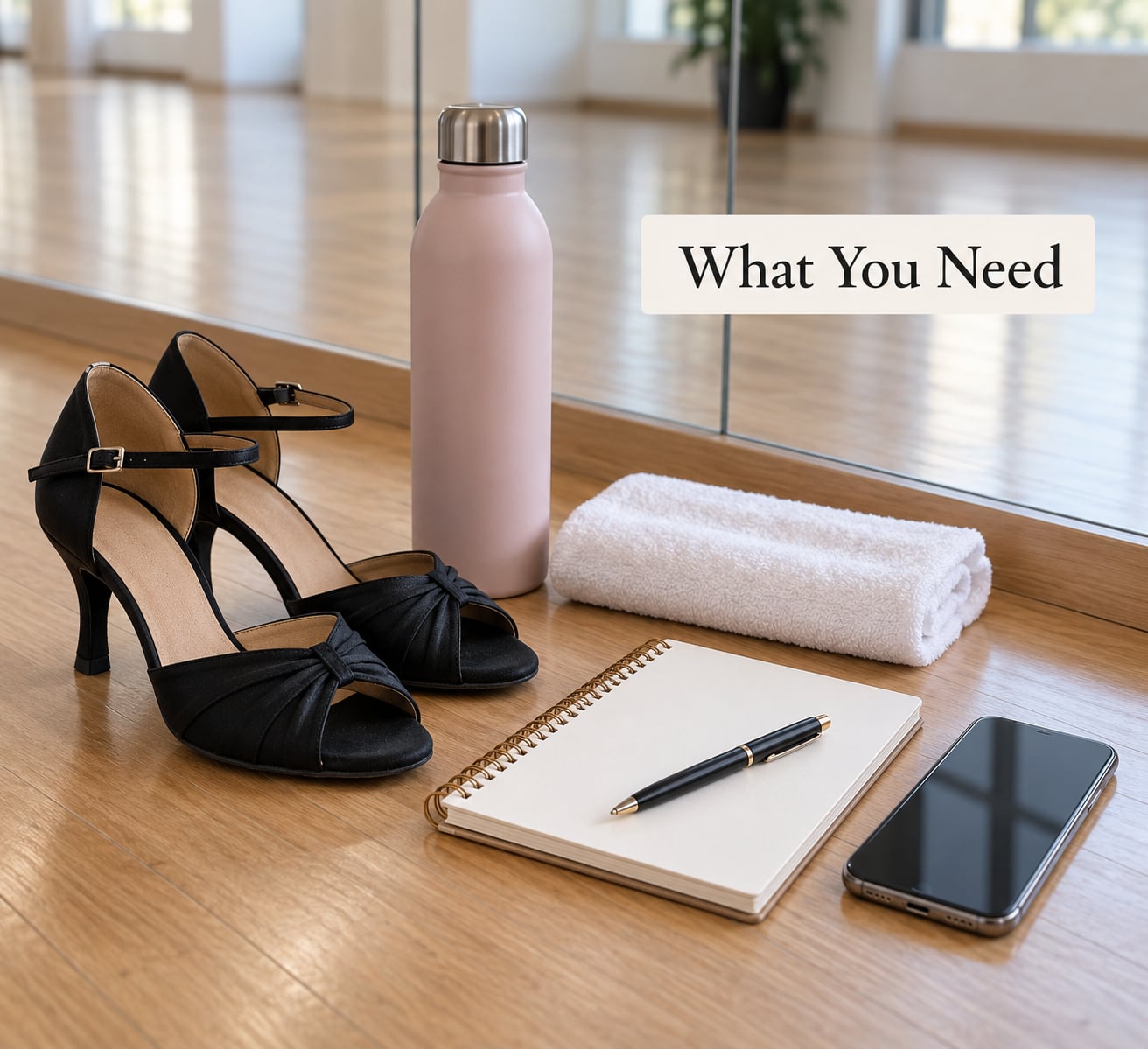
You need very little to start. Most beginners buy gear first and skills never arrive, so put the shoes on and learn something before you spend anything.
- A pair of comfortable shoes with smooth, clean soles. Sneakers with fresh rubber or soft-soled flats work on a hard floor. You can learn ballroom basics perfectly well before you own dance shoes.
- A clear patch of floor. Six feet by six feet is enough for the basic step. Push chairs back and turn off the rug, because a rug swallows your footwork cues.
- A mirror, or your phone on a tripod. A mirror shows your posture in real time. Video shows timing more honestly than a mirror does, since you can watch it back slowed down.
- Music with a steady beat. Any slow ballroom track will do. Pick one and use it for weeks, because familiarity with a track makes timing easier to hear.
- A notebook or phone note. Write down patterns as counts. Most beginners forget figures because they never wrote them down.
- Somewhere to dance with other people. One group class a week is enough. If nobody is available, social dance nights and beginner drop-ins fill the same gap.
- Water and flat floor. Two minutes of stretching before and after keeps your feet and knees happier than you would expect.
That is the whole kit. Everything else, including a first dance outfit for a class, you can worry about once you know what a basic step looks like.
Step-by-Step: How to Learn Ballroom Basics in Six Steps
Six steps, in this order, is roughly the first month of a beginner’s life. Skipping ahead feels faster and reliably costs you more time later.
Start With One Easy Step
Choose one beginner-friendly ballroom style and stay there for a month. Waltz is the most common starting point because its timing is slow and predictable, and its basic step, the box step, works in every standard ballroom dance.
Learn a single step pattern at a time, and only add a second one once the first one is boring rather than difficult. Boring is the signal you have moved on. If you are still hesitating on footwork, you are not ready for another figure yet.
How to know it is working: you can name the pattern, say how many counts it takes, and start it from a standstill without thinking.
Learn Your Starting Position
Start from a comfortable standing position rather than a dramatic pose. Feet about hip-width apart, knees soft, weight forward and centred over the balls of your feet, shoulders down, head level.
Alignment matters more than appearance. A slightly bent knee and a tall spine let you turn without losing balance, while a stiff, leaned-back stance locks you into every awkward moment.
Hold that position for a full minute and notice where you tense. Most beginners grip their shoulders and their lower back. Practise until the position feels ordinary rather than held.
How to know it is working: someone can push gently on your shoulder and you correct yourself without thinking about it.
How to Learn Ballroom Basics One Step at a Time
Break the basic step into three jobs and practise them apart before putting them together. First, the weight transfer: which foot carries your weight on each count. Second, the footwork: which foot moves and in which direction. Third, the timing: which beat each movement lands on.
A simple beginner drill covers the whole pattern. Play the track slowly, step through the pattern without music, then add the music at half speed in your head. Count out loud before you count silently, and tap your foot on the first beat of each bar so you hear where you are.
You are looking for balance and repeatability, not smoothness. If you can do the pattern ten times in a row and only wobble twice, it is good enough to build on.
How to know it is working: you can restart mid-pattern after a mistake without losing the count.
Add Your First Turn or Travel
Only add the next movement once the basic step feels steady. A turn on every fourth count is the usual first addition, and most ballroom styles share it.
Give yourself space. Turning needs room, so practise near a wall or in the middle of an empty floor rather than between a coffee table and the sofa. Move slowly, and stop the turn before you get dizzy rather than pushing through it.
Keep travelling straight for the first week. Beginners drift in a slow circle without noticing, and a pattern that travels where you meant it to go feels completely different.
How to know it is working: you can turn without looking down and still arrive facing the same wall afterwards.
Work on Partner Skills
Ballroom is a conversation. One person leads, the other follows, and the useful part of learning it alone is that you can practise both halves, so try switching which side you take.
Learn the closed hold first. A firm, comfortable frame between your shoulders and your partner’s is what carries the movement, and hand positions matter less than everyone agreeing where they are. Your instructor or the video you are watching should set the hand position once and then repeat it.
Feedback should be specific and kind. Say what you felt rather than what someone did wrong: the floor was slippery, the beat drifted, the turn pulled you off line. Practising with a partner is far faster than solo work, and one honest conversation about frame saves a month.
How to know it is working: you can dance a short pattern with someone new without either of you saying a word.
Build a Repeatable Practice Routine
Turn the individual skills into a schedule you will actually keep. Ten minutes a day, five or six days a week, beats two hours on a Sunday. Short frequent sessions build the movement into your body; long rare ones just let you rediscover what you forgot.
Track progress without turning it into a performance review. Record ten repetitions once a week and compare with the week before, in this order: does your weight transfer land on the beat, can you repeat it, can you add it to what you already knew. Those three checks tell you whether you are improving even on a week it does not feel like it.
Once you can do a pattern reliably with a partner, take it to a social dance night. Dancing with strangers is a completely different skill from dancing in a studio, and the only way to close that gap is to do it.
How Long Does This Take?
Expect your first usable pattern in one or two lessons, a comfortable basic step in three to four weeks with regular practice, and a few short dances you can use socially in three to six months. Those numbers assume short daily sessions and one class a week.
The people who feel slower are usually learning three dances at once. Pick one, finish it, and move on.
Common Mistakes
Almost every beginner hits at least three of these. None of them are talent problems.
Rushing Transitions
Practising a pattern at full speed from day one is the most common error, and it hides every other mistake. Slow it down until the transition between steps is deliberate, then build speed over several sessions rather than in one.
Correction: practise the last two steps and the first two steps of the next pattern as one slow loop, five times, before you ever run the whole thing.
Practising Without a Reference
Guessing at a figure from memory produces something that looks almost right, which is the hardest version to fix. Keep the source you learned from and return to it, even if you are certain you remember.
Correction: film a short reference clip of any figure you cannot recall yet, and re-watch it before practising.
Holding Tension
Gripped shoulders, a clenched jaw and a locked knee turn a beginner into a stiff partner. Tension in the upper body travels straight down to the feet.
Correction: lower your shoulders deliberately every few counts, and check once a minute that your jaw is unclenched. Notice it early and it stops being a problem.
Learning Too Many Figures
Six patterns you can barely do are worth less than one pattern you can lead without thinking. Breadth feels productive and is not.
Correction: hold a one-figure limit until your current figure survives a full social dance without a restart.
Ignoring Safe Technique
Twisting an ankle mid-turn, dancing in smooth-soled shoes on a hard floor, or skipping a warm-up all cause injuries that end beginners’ interest permanently. A two-minute warm-up and a flat floor prevent nearly all of it.
Correction: warm up ankles, calves and hips before every session, and stop any turn that feels sharp in the knee.
A few habits that pay off quickly: practise the timing by clapping before you step, film yourself once a week rather than every session, and tell your instructor or partner the single thing you want fixed this week. Feedback narrowed to one point is far more useful than a list.
Frequently Asked Questions
Can I learn ballroom basics without a partner?
Yes, for the first month or so. Posture, footwork, weight transfer, timing and the basic step pattern all train solo, and switching sides lets you practise leading and following. A partner becomes useful once you start frame, hand positions and connection, so join a group class, a drop-in social or a beginner rotation night once the basic step feels steady on its own.
What is the easiest ballroom dance for beginners?
Waltz is usually the easiest, then Foxtrot and Rumba. Waltz moves slowly, its beat is predictable and its basic box step transfers straight into Tango, Quickstep and Viennese Waltz. Foxtrot adds more variety but stays at a gentle tempo. Rumba is forgiving about imperfect timing. Viennese Waltz and Quickstep are the hardest for beginners because of speed and footwork demand.
Do I need special shoes to learn ballroom?
Not at the start. Comfortable shoes with smooth, clean soles on a hard floor work fine for your first several months. Buy dedicated shoes once you take classes regularly, because pivoting in sneakers wears them out and makes turns feel slippery. If you start social dancing, soft-soled jazz or Latin shoes give you much better control than heavy trainers.
How long should I practice each day?
Ten minutes a day, five or six days a week, is enough to make real progress. Short frequent sessions build muscle memory better than one long weekly practice. Break the ten minutes into three minutes of timing work, four minutes of the step pattern without music, and three minutes with music. If you have more time, extend the pattern practice rather than the session length.
Should I take a class or learn from videos?
Use both, for different jobs. Classes give you a partner, immediate correction on frame and timing, and other people to practise with, which is where most progress comes from. Videos are better for repetition at home, for seeing a figure from above, and for slowing a pattern down. Learn a pattern from one source only, then practise it from that same source until it is solid.
How do I remember ballroom combinations?
Write them down as counts rather than trying to memorise them visually. Write each pattern as a line like 1 to 6, note the feet you travel on, and say the counts out loud while practising the first few times. Practise one pattern at a time for a week before chaining two together, because most forgotten combinations were two correct patterns that were never practised as a link.
Conclusion
Choose one dance, learn one basic step pattern, and practise it for ten minutes a day before anything else. Waltz and its box step are the easiest place to begin, and the fundamentals you build there carry into every standard ballroom style afterwards.
Book a beginner class or a social dance night this week so you have other people to move with, and be patient with yourself for the first month. Everyone learning ballroom basics starts by getting the weight transfer slightly wrong. Fixing it once, carefully, is worth more than practicing a hundred other figures badly.