Writing a dating profile that sounds like you comes down to one thing: swapping broad, flattering claims for details only you would use. Replace “I love travel and good food” with the specific thing you ordered, the neighborhood you drive back to, the tiny ritual nobody else bothers with. What makes a profile land is self-relevance, the sense that the writer actually wants to be known, and a tidy list of shared virtues does the exact opposite. It takes about 45 minutes to do properly, and you only need a few honest notes to start.
Most profiles fail for the same reason. They sound impressive and completely anonymous, so a match has nothing to reply to except a compliment that fits half the grid. The fix is rarely more text. It is truer text, in the vocabulary you would actually use on a Tuesday night with a friend.
Table of Contents
- What You Need
- Step-by-Step: How to Write a Dating Profile That Sounds Like You
- 1. Start with a simple plan for how to write a dating profile that sounds like you
- 2. Lead with a detail that starts a conversation
- 3. Describe your interests through lived moments
- 4. Choose traits and values that clarify who you are
- 5. Write in your everyday speaking voice
- 6. Add specific dating preferences without sounding demanding
- 7. Add a low-pressure invitation to connect
- Common Mistakes
- Frequently Asked Questions
- How can I learn how to write a dating profile that sounds like me without sounding fake?
- What should I put in a dating profile when the app has a short character limit?
- Should I mention LGBTQ+ identity, community involvement, or queer culture in my dating profile?
- How do I write dating-profile photos if I am shy or do not like being photographed?
- How do I balance being honest with not sharing private information?
- Start With One Honest Draft
What You Need
You need about forty-five minutes and three raw notes, and that is the whole supply list.
- Three specific activities. Not categories, actual instances. “Cooking” is a category. “Making a beef stew that ruined my oven at midnight” is an instance.
- Three qualities your friends would use. Ask three people what you are like. The overlap between their answers is your actual personality, not the one you auditioned for.
- One thing you would happily talk about for an hour. This is your conversation starter. A person who has a real answer here never runs dry on a first date.
- The character limit of the field you are writing. Most dating app bio fields cap out somewhere between 150 and 300 characters, and prompt answers are usually shorter. Find the number before you write, not after.
- Room to revise and read it out loud. A draft is not a draft until you have said it out loud and heard how it sounds.
One piece of community folklore worth knowing about: the 333 rule suggests keeping your profile around 333 characters, roughly three times the average bio length. Nobody wrote it down and no platform enforces it, so treat it as a useful floor rather than a rule. If you cannot make a sentence work in 333 characters, the sentence is usually doing too much.
Step-by-Step: How to Write a Dating Profile That Sounds Like You
1. Start with a simple plan for how to write a dating profile that sounds like you
Before you open the app, write down three things you did last week that you enjoyed, three words friends have used to describe you, and one thing you want someone to know about you within the first ten minutes of meeting. Keep this list on your phone. It exists so that when you sit down to type, you are transcribing instead of inventing.
Skip the list and you will produce adjectives, because adjectives are all that is available in an empty box. “Adventurous,” “grounded,” and “a little shy” could describe nine out of ten people in your area. The list is where the specificity comes from, and it takes four minutes.
2. Lead with a detail that starts a conversation
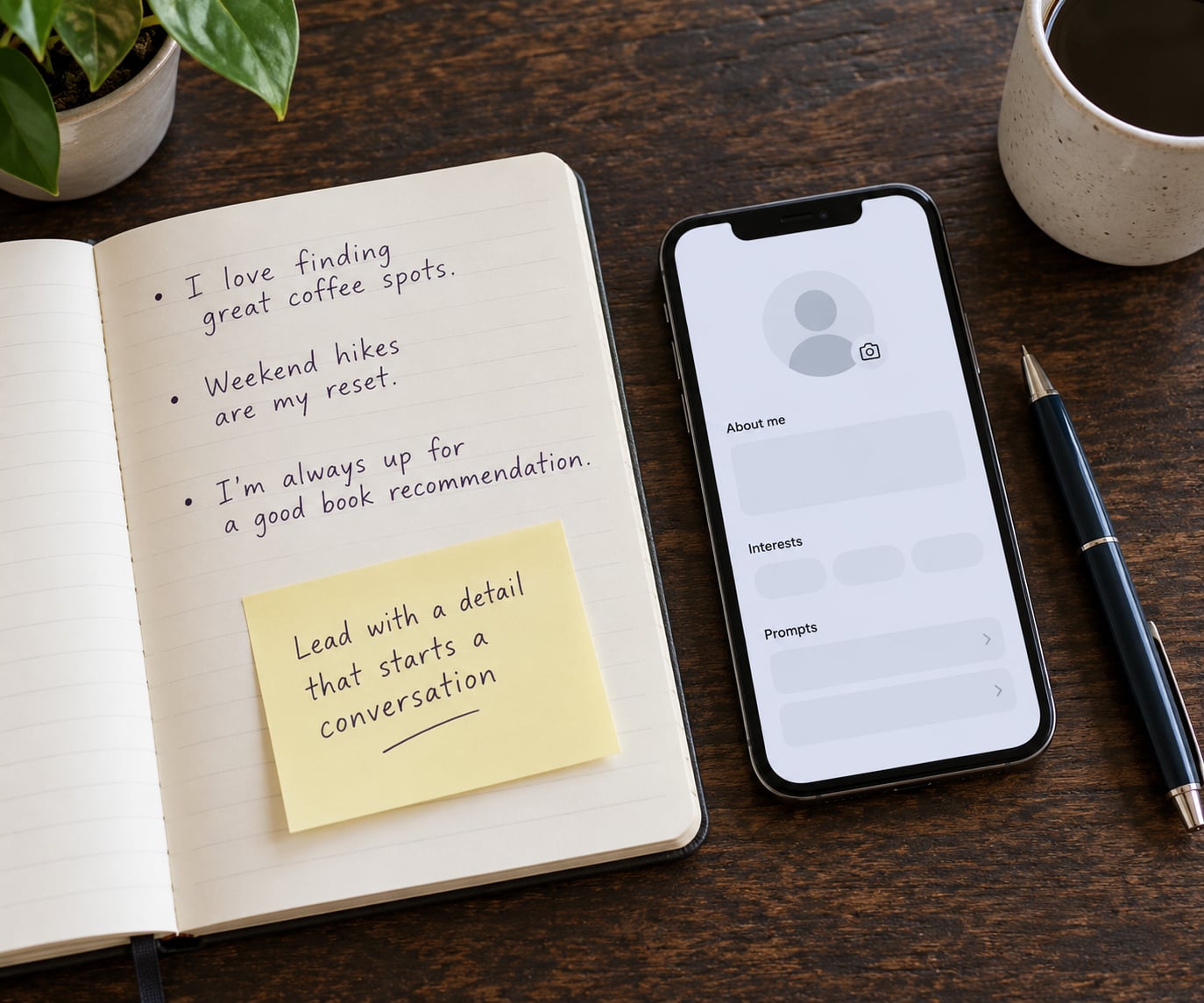
Your first line should do two jobs: say something true and make replying easy. A vague opener cannot. “I just enjoy life” tells a stranger nothing, so they scroll.
A low-pressure hook does the work. Here are some that work because they could only have been written by a real person:
- “My Friday night involves a specific taqueria on 18th and nowhere else.”
- “I will absolutely make you a tasting menu, and you will regret ordering seconds.”
- “Third week of learning the violin badly. My neighbors are being gracious.”
- “I run the kind of book club where we argue about footnotes.”
- “Two years sober, one year into a pottery hobby that has cost me an arm.”
- “I know which block parties have the good jello and which ones are a police-state checkpoint.”
Notice that none of these try to be funny on demand. They are specific, and the specificity is doing the charm. If the venue, the jello, or the violin is genuinely part of your week, the line works. Borrow it and it will read thin within a message or two.
3. Describe your interests through lived moments
Most bios list hobbies like a menu, and a menu tells a reader nothing about what you are like. Instead, describe how an activity actually happens in your life or what you notice while doing it.
Flat version: “Hiking, cooking, and live music.” Lived version: “My hikes are slow and I talk the entire time. I have strong feelings about the correct way to make eggs, and I make them for friends before I’ve met them.” The second one still shows you at a trailhead; the first one could be anyone.
The test is whether the line gives someone a way in. “I make them for friends before I’ve met them” invites a question. “I like live music” does not.
4. Choose traits and values that clarify who you are
Pick two or three qualities, and support each one with something you do. Unsupported traits read as a wish list, and claiming every good quality at once reads as unbelievable.
Honesty, supported: “I will tell you I don’t like your restaurant pick in the first ten minutes.” Introversion, supported: “I need one solid hang before I am fun company, and then I’m very fun company.” Caretaking, supported: “I have been the one who remembers the medication refill, so I am usually the one who remembers.”
You do not need a trait for every dimension of your personality. Two well-supported qualities read as a person. Six read as someone filling out a form.
5. Write in your everyday speaking voice
Most profiles sound off because the writer switched registers halfway through. The bio starts casual and then turns into a press release about a “partner who values growth and authenticity.”
The fix is the read-aloud test. Say each line out loud. If you would not say it to a friend at a bar, cut it or loosen it. Also remove jargon, slogans, and heavily romantic declarations, which are almost always borrowed phrasing pasted over your actual personality.
Before: “I am a kind and driven individual seeking a partner who values authenticity and mutual growth.” After: “I cook too much for one and I am looking for someone who will tell me when the soup needs salt.” Same warmth, but now it reads like speech.
There is one more thing to watch for: slang that does not belong to you. A single well-placed curse or piece of vernacular reads as personality. Three, in a bio, read like a costume.
6. Add specific dating preferences without sounding demanding
Say what kind of connection you want and what you would enjoy doing together, then leave the rest open. Rigid wish lists read as a contract, and a bare “just message me” reads as no interest at all.
Vague: “Looking for something serious, no fakers.” Better: “Looking for someone who wants to cook on a Sunday and argue about what to watch, and who texts back within a day or two.” Rigid: “Must be 6 foot, ambitious, never drinks.” Flexible and honest: “I am ambitious about my own work and would like to meet someone who is, too, but I care much more about being easy to talk to at dinner.”
Flexibility is not settling. It is a signal that you know what you actually care about.
7. Add a low-pressure invitation to connect
End with one friendly prompt tied to something specific in the profile. Not a demand, and not “Just message me,” which does all the work on them.
Some templates: “Tell me the worst phase of disco you have lived through.” “If your answer involves a bus and a folding table, we should talk.” “Debate welcome: is it worse to miss the last train or to be on the wrong train entirely?”
Whatever you write should be answerable in one or two sentences. That is the whole bar. The invitation should make responding easy and expect nothing about how or when.
One last check before you publish: read the whole profile as if it were going to someone you work with, and scan for anything that gives away your last name, your exact workplace, your apartment number, or a private account. Save the precise details for the conversation, once you know who you are talking to.
Common Mistakes
Here are the eight patterns that show up most, with a revision attached to each.
Overused openers. “Love to laugh,” “who doesn’t want to have fun,” and “here for a good time.” They add no information and they date the profile instantly. Replace the phrase with a specific moment from your week.
Adjective piles. “Fun, outgoing, ambitious, thoughtful.” Nobody reads four claims in a row and believes any of them. Keep two, and attach a behavior to each.
Excessive formality. Full sentences in business register read like a cover letter. Say it the way you would say it out loud.
Contradictions. “I hate drama” written directly under a paragraph about how drama makes things interesting is a real problem. Pick one position and drop the rest.
Vague relationship goals. “Open to anything” and “looking for my soulmate” fail for opposite reasons. Say what you want to be doing with a person, concretely.
Borrowed humor. If a joke comes from a listicle, it will not survive a conversation. Keep only the lines where you can picture yourself actually saying them.
Oversharing. Ex names, therapy diagnoses, family drama, and salary numbers belong to a conversation, not a grid. Say you are working through something; save the rest.
Copying someone else’s voice. A profile modeled on a template reads like a template, and people can tell. Use the structure, throw away the phrasing.
Length is less important than it seems. A 150-character field rewards one sharp line. A 300-character field rewards one line plus one specific detail. Only on apps with open bio sections does longer writing pay off, and even there, six short lines beat three dense paragraphs every time.
Frequently Asked Questions
How can I learn how to write a dating profile that sounds like me without sounding fake?
Start with the swap test: if you could paste your bio onto someone else’s profile and it would still make sense, it is not sounding like you. Write down three real activities and three words friends use about you, then build each line around one concrete detail. Read the draft out loud and delete anything you would not say in conversation. The fake-sounding quality almost always comes from borrowed phrasing, not from the topic itself.
What should I put in a dating profile when the app has a short character limit?
Prioritize four things and drop the rest: one memorable opener, one specific interest with the reason you enjoy it, one personal quality supported by a behavior, and one clear but flexible dating preference. Use line breaks so each idea gets its own visual line on a phone screen. A short field rewards one sharp sentence far more than three crammed claims, and most people read it in seconds.
Should I mention LGBTQ+ identity, community involvement, or queer culture in my dating profile?
Mention it when it is genuinely part of your life or the kind of connection you want, and keep the detail personal rather than leaning on stereotype. A line about a specific venue, volunteer role, or community ritual tells a reader more than listing your identity does. You are never obligated to disclose anything before you have met, and a profile is a safe place to control exactly how much someone learns.
How do I write dating-profile photos if I am shy or do not like being photographed?
Choose a small number of clear, recent images that represent different parts of your life. A relaxed smile, an activity you genuinely enjoy, a creative hobby, or a friendly group photo can all work, and you do not need to be the most polished person on the grid. Skip the bathroom mirror, the group shot where you are cut off, and anything older than a couple of years.
How do I balance being honest with not sharing private information?
Share the part of yourself that invites conversation and hold back the part that could put your safety at risk. Interests, values, and a neighborhood are fine. Your surname, exact workplace, apartment details, private social accounts, and anyone else’s identity are not. If you are not out to family, employer, or housemates, say as much as you want and nothing more, and revisit it as you get to know someone.
Start With One Honest Draft
Pick three details that are genuinely yours. Turn them into one conversational opener, one short section on an interest or a value, and one gentle invitation to reply, then read the whole thing out loud in your normal speaking voice. Cut anything that sounds borrowed, and keep the rest. A dating profile that sounds like you does not need to be impressive. It only has to be recognizable.